Can You Have a Hair Transplant With a High Norwood Stage?

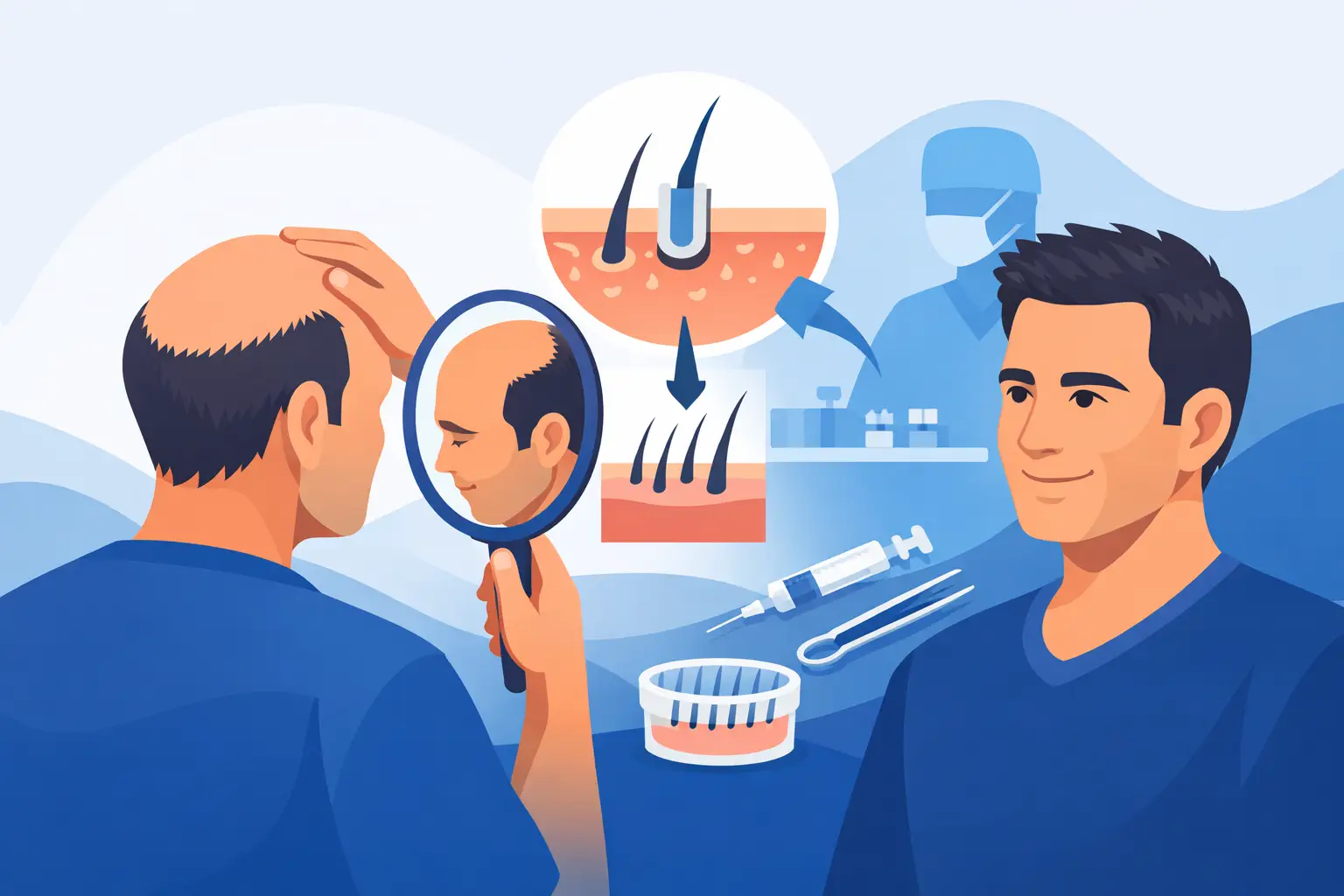
Can you have a hair transplant with a high Norwood stage? Learn candidacy factors, graft planning, realistic density, and next steps with experts now.
- What a High Norwood Stage Means for Transplant Planning
- Can You Have a Hair Transplant With a High Norwood Stage?
- How Grafts Are Prioritized in Advanced Hair Loss
- Which Technique Is Best for a High Norwood Stage?
In this article8
- What a High Norwood Stage Means for Transplant Planning
- Can You Have a Hair Transplant With a High Norwood Stage?
- The donor area is the deciding factor
- Your hair loss must be planned for, not ignored
- How Grafts Are Prioritized in Advanced Hair Loss
- Which Technique Is Best for a High Norwood Stage?
- What Results Can You Realistically Expect?
- Questions to Ask Before You Commit
A Norwood 5, 6, or 7 diagnosis can make the mirror feel decisive: the hairline has receded significantly, the crown is open, and the remaining hair may seem too limited to make a difference. But can you have a hair transplant with a high Norwood stage? In many cases, yes. The more accurate question is whether your donor supply, hair characteristics, long-term hair loss pattern, and aesthetic goals can support a result that looks natural for years to come.
A high Norwood stage demands more planning than an early-stage procedure. It is not simply a matter of placing the largest possible number of grafts. A successful transplant must use a limited donor resource intelligently, prioritize the areas that frame the face, and create density that remains convincing as you age.
What a High Norwood Stage Means for Transplant Planning
The Norwood scale describes the progression of male pattern hair loss. While early stages usually involve temple recession or a thinning crown, higher stages commonly mean extensive loss across the frontal scalp, mid-scalp, and vertex. At Norwood 6 or 7, the remaining permanent hair is often concentrated in a horseshoe-shaped band around the sides and back of the head.
This matters because donor hair is finite. During FUE or Sapphire FUE, grafts are extracted from the donor area one by one. They do not regenerate there. The purpose of expert planning is to use those grafts where they will have the strongest visual impact without overharvesting the donor zone or designing a hairline that cannot be supported in the future.
High-stage patients can achieve a major aesthetic change, particularly when they have stable, healthy donor hair. However, the goal should usually be strategic coverage and a natural overall impression rather than the same density seen in someone who never experienced hair loss.
Can You Have a Hair Transplant With a High Norwood Stage?
Yes, provided you are an appropriate candidate. A high Norwood stage does not automatically disqualify you from surgery, but it does make a physician-led assessment essential. Two people with the same Norwood classification may have very different outcomes because their donor density, hair shaft thickness, scalp contrast, and future loss pattern are not the same.
Thick, wavy, or curly hair often provides stronger coverage per graft than fine, straight hair. Lower contrast between hair and scalp can also make transplanted coverage appear fuller. Conversely, a patient with fine hair, very limited donor reserves, and extensive scalp loss may need a more conservative design or a staged plan.
At HairNeva, a detailed assessment can include AI-powered HairMetrix analysis to evaluate hair density and donor capacity with greater precision. This supports a plan based on measurable information rather than promises made from photographs alone.
The donor area is the deciding factor
For high Norwood cases, the donor area is often more important than the visible bald area. A surgeon evaluates donor density, the thickness of individual hairs, the proportion of stable hairs, scalp condition, and whether extraction can be distributed safely.
A strong donor area may support a substantial restoration over one or two sessions. A limited donor area may still allow a meaningful improvement, but the design needs to be selective. In these cases, focusing on the frontal hairline and mid-scalp can create a more youthful, balanced appearance than spreading grafts too thinly across the entire scalp.
Beard hair can sometimes supplement scalp donor grafts for selected patients. Its texture is different, so it is generally used thoughtfully, often behind the hairline to increase visual density. This is a specialized decision, not a standard substitute for scalp donor hair.
Your hair loss must be planned for, not ignored
Male pattern hair loss may continue after a transplant. If native hairs behind the transplanted zone continue to thin, an overly low or dense hairline can eventually look disconnected from the rest of the scalp.
This is why an experienced physician considers your family history, age, current progression, and medical treatment options before finalizing the design. A mature, age-appropriate hairline may sound less dramatic than an aggressive one, but it is often the choice that delivers a better long-term result. Naturalness comes from proportion, irregularity at the leading edge, and a distribution that respects your likely future pattern of loss.
How Grafts Are Prioritized in Advanced Hair Loss
A high Norwood transplant is an exercise in visual priorities. The frontal hairline and frontal third of the scalp usually receive the greatest attention because they are most visible in conversation, photographs, video calls, and everyday life. Restoring this area can change the way the entire face is perceived.
The mid-scalp is often treated next to create continuity from the hairline backward. The crown may be addressed during the same procedure if donor reserves are generous, or it may be planned as a later session. The crown is a large area that can consume a high number of grafts, especially when it is completely open. Giving it equal priority too early can leave the frontal zone underpowered.
A well-designed transplant also uses different graft types deliberately. Single-hair grafts are usually placed at the hairline to create a soft, refined transition. Grafts containing two or more hairs are placed behind it to build coverage. The angle and direction of implantation matter just as much as the graft count. Poor direction can make even a high-graft procedure look unnatural.
Which Technique Is Best for a High Norwood Stage?
FUE, Sapphire FUE, and DHI can all be suitable, but the best technique depends on your scalp, donor characteristics, desired coverage, and the clinical plan. There is no single method that automatically produces the best result for every advanced hair loss case.
FUE is widely used for extracting individual follicular units with no linear scar. Sapphire FUE uses sapphire blades to create recipient channels with controlled angles and sizes, supporting precise placement and a minimally invasive recovery process. DHI uses an implanter pen for direct placement and can be valuable when the placement strategy calls for detailed control.
The method should follow the plan, not replace it. A premium result depends on safe harvesting, graft survival, aesthetic design, and surgical execution by an experienced medical team. Patients should be cautious of clinics that present an unusually high graft number as the only marker of quality. Taking too many grafts can permanently weaken the donor area and limit future options.
What Results Can You Realistically Expect?
For a high Norwood patient, the most rewarding result is usually not a perfectly dense scalp under harsh overhead lighting. It is a natural-looking hairline, stronger facial framing, and coverage that allows you to style your hair with greater confidence.
New growth typically begins to become noticeable between three and four months after surgery. Visible improvement continues over the following months, while more mature texture and density often develop around 12 months. Crown growth can take longer to fully reveal itself.
Your physician may recommend complementary therapies such as PRP, mesotherapy, laser-supported hair care, or medically appropriate treatment to support existing native hair. These treatments do not create unlimited donor supply, but they may help protect the hair you still have and improve the overall appearance of the result.
Questions to Ask Before You Commit
Before booking surgery, ask how many grafts can be harvested safely, which zones will be prioritized, and whether a second session is likely. Ask to see before-and-after cases with a similar Norwood stage, hair type, and donor profile. A credible clinic should discuss limitations directly, not only show ideal outcomes.
You should also understand who will perform each part of the procedure, how the donor area will be monitored, and what aftercare is included for international patients. High-stage restoration is a long-term medical and aesthetic decision. Clear communication before travel is part of safe care.
A high Norwood stage may require a more conservative strategy, but it does not mean you have missed your opportunity. With an honest donor assessment, precise surgical planning, and a design built around your face rather than a number on a chart, meaningful restoration can still be within reach.