What Is the Best Hair Transplant for Women?
Learn how to choose the best hair transplant for women, from FUE and DHI to candidacy, hairline design, recovery, and natural density goals now.
- What makes the best hair transplant for women?
- FUE vs. DHI for female hair restoration
- Why female hairline design requires a different eye
- Can women have an unshaven hair transplant?
In this article9
- What makes the best hair transplant for women?
- FUE vs. DHI for female hair restoration
- FUE for broader coverage and flexible planning
- DHI for precision between existing hairs
- Why female hairline design requires a different eye
- Can women have an unshaven hair transplant?
- Donor protection is the foundation of long-term results
- What recovery and growth really look like
- Questions that lead to a safer decision
For many women, the question is not simply whether a transplant can restore hair. It is whether the result can look completely believable in close conversation, under bright light, and with the parting style they wear every day. The best hair transplant for women is therefore not one named technique for everyone. It is a physician-led plan that protects existing hair, uses donor grafts responsibly, and rebuilds density with a soft, age-appropriate design.
Women often arrive for consultation after years of trying to disguise widening parts, visible temples, or thinning around a prior scar. A transplant can be a highly effective solution when the cause of loss is correctly diagnosed and the donor area is strong enough. But it should never be treated as a one-size-fits-all cosmetic procedure.
What makes the best hair transplant for women?
The right procedure begins with the pattern of loss. Some women have stable thinning at the frontal hairline or temples, while others have traction alopecia from repeated tension, hair loss after surgery, or a naturally high hairline. These concerns can respond very differently from diffuse thinning caused by hormonal changes, nutritional deficiencies, thyroid conditions, autoimmune disease, or active female-pattern hair loss.
A responsible evaluation looks beyond the visible area. The surgeon should assess the density and caliber of hair throughout the scalp, examine the donor zone, review medical history and medications, and determine whether hair loss is stable. Digital analysis can help establish a baseline by measuring density and hair shaft variation. At HairNeva, AI-supported hair analysis can be used alongside clinical examination to support precise planning rather than relying on a single photograph or a generic graft estimate.
The best candidate usually has a defined area that needs restoration, healthy donor hair at the back and sides of the scalp, and realistic expectations about coverage. A woman with active, widespread shedding may need medical evaluation or regenerative support before surgery is considered. Transplanting into an unstable pattern without a long-term plan can leave the result looking uneven as native hair continues to thin.
FUE vs. DHI for female hair restoration
For most suitable candidates, FUE and DHI are the leading approaches. Neither is automatically superior. The best choice depends on the recipient area, the amount of existing hair, the desired density, and whether discretion during recovery is a priority.
FUE for broader coverage and flexible planning
Follicular Unit Extraction, or FUE, involves harvesting individual follicular units from the donor area and placing them into recipient sites prepared at carefully controlled angles and directions. It is commonly selected for women who need restoration across a wider area, such as the frontal scalp, temples, or a scar.
The strength of FUE is its flexibility. A surgeon can create a distribution plan that prioritizes the hairline, the part line, or the zones where visual density matters most. Sapphire FUE uses blades made from sapphire to create recipient channels with fine control. This may be useful when planning dense, precise placement, but the material of the blade alone does not determine the quality of a result. Surgical judgment, graft handling, and natural design matter far more.
DHI for precision between existing hairs
Direct Hair Implantation, or DHI, places grafts with a specialized implantation pen. For women with significant native hair still present, this approach can be especially useful because it may allow controlled placement between existing strands without extensively shaving the recipient area.
DHI can be an excellent option for refining the frontal hairline, reinforcing a widening part, or adding density to localized thinning. It is not a shortcut to unlimited density, however. Each graft must still be harvested safely, handled carefully, and implanted at an angle that respects the natural direction of growth. When clinics market DHI as universally better, they overlook the fact that technique should follow the patient’s anatomy, not the other way around.
Why female hairline design requires a different eye
A successful female transplant is often defined by what no one notices. The hairline should not look straight, harsh, or artificially low. It needs subtle irregularity, fine single-hair grafts at the leading edge, and a transition that matches the patient’s facial proportions, age, and hairstyle.
Female hairlines also tend to require careful temple work. The angle at which hair exits the scalp is extremely flat in this area. If grafts are placed too upright or too densely in a uniform pattern, the result can appear plug-like even when the grafts survive well.
Density is equally strategic. A skilled surgeon does not simply fill every available space. The plan should consider the patient’s part, how she wears her hair, and where a small increase in density will create the greatest aesthetic change. In many cases, a conservative, well-designed first procedure is more convincing and more sustainable than an aggressive graft count.
Can women have an unshaven hair transplant?
Often, yes. An unshaven or minimally shaved procedure can be particularly appealing to professionals, public-facing patients, and anyone who wants to keep treatment private. The donor area may be trimmed in small concealed sections while the surrounding hair remains long enough to cover it.
This option is not suitable for every case. It can make surgery more technically demanding and may limit the number of grafts that can be harvested efficiently in one session. Women requiring extensive coverage may benefit from a more traditional preparation because it gives the surgical team clearer access and greater control. The best approach is the one that balances discretion with graft quality and safe harvesting.
Donor protection is the foundation of long-term results
The donor area is not an unlimited resource. This is particularly relevant for women with diffuse thinning, where hair at the back of the scalp may also be affected. Removing too many grafts, or harvesting them unevenly, can make the donor area appear thin and compromise options for the future.
A surgeon-led plan should identify safe donor zones and set a graft target that preserves a natural appearance after healing. It should also account for the possibility of future hair loss. If a patient is likely to need more restoration later, donor management is not a technical detail. It is the long-term strategy.
This is why a low price or an unusually high graft promise should not be the deciding factor. The quality of the donor assessment, the experience of the medical team, and the clinic’s willingness to say no when surgery is not appropriate are stronger indicators of patient safety.
What recovery and growth really look like
The implanted area typically forms tiny scabs during the first days after surgery. Mild swelling or tenderness can occur, particularly around the forehead after frontal placement. Most patients can return to low-impact daily activity quickly, but they should follow the clinic’s washing instructions and avoid friction, strenuous exercise, swimming, and direct sun exposure during early healing.
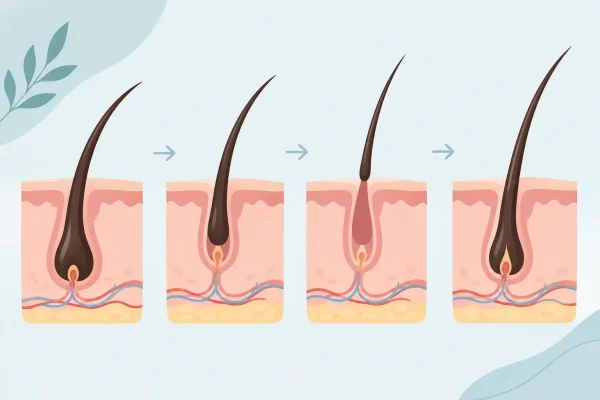
Transplanted hairs commonly shed within the first few weeks. This is expected and does not mean the follicles have failed. New growth often begins gradually around three to four months, becomes more noticeable between six and nine months, and continues to mature for up to 12 to 18 months. Curly or textured hair, scar restoration, and areas with limited blood supply can follow a different timeline.
Existing hair also needs ongoing attention. Depending on the diagnosis, a physician may recommend medical therapies, platelet-based treatments, laser-supported care, or other supportive options to help protect native strands. A transplant adds permanent follicles where they are placed, but it does not stop unrelated hair loss elsewhere on the scalp.
Questions that lead to a safer decision
Before choosing a clinic, ask who performs the diagnosis, who designs the hairline, who extracts and implants the grafts, and how donor safety is measured. Ask to see results from women with a similar hair type, pattern of loss, and starting density. A photo of a dense result is less meaningful if it does not resemble your own clinical situation.
International patients should also understand what is included in their care plan. Clear communication before travel, realistic graft planning, postoperative guidance, and accessible follow-up support make a meaningful difference when treatment takes place abroad. Premium care is not only about the operating room. It is about the quality of decision-making before surgery and support after it.
The right transplant should give you more than added hair. It should give you the confidence to wear your preferred part, step into bright rooms without planning around your scalp, and recognize yourself in photographs again.