What Happens to Hair Follicles During the Growth Cycle?
Learn what happens to hair follicles during the growth cycle, why shedding occurs, and how expert assessment helps identify common patterns behind thinning.
- What Happens to Hair Follicles During the Growth Cycle?
- When the Cycle Changes: Shedding vs. Miniaturization
- Why Follicle Health Matters Before a Hair Transplant
- A More Precise Way to Assess Your Hair Cycle
In this article8
- What Happens to Hair Follicles During the Growth Cycle?
- Anagen: the active growth phase
- Catagen: the controlled transition
- Telogen: the resting phase
- Exogen: when the old strand sheds
- When the Cycle Changes: Shedding vs. Miniaturization
- Why Follicle Health Matters Before a Hair Transplant
- A More Precise Way to Assess Your Hair Cycle
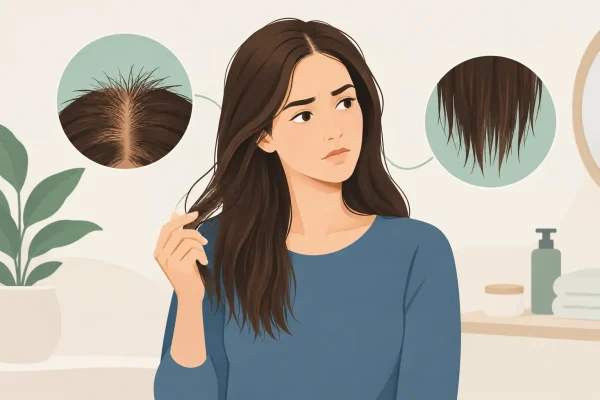
Hair on your pillow, in the shower drain, or on a brush can be unsettling, especially when you are already noticing less density around the hairline, crown, or part. But shedding is not automatically hair loss. To understand the difference, it helps to know what happens to hair follicles during the growth cycle and why a follicle can either return to productive growth or gradually produce finer, shorter hair.
Each follicle is a living mini-organ beneath the skin. It does not grow continuously forever. Instead, it moves through a repeating sequence of active growth, transition, rest, and release. The quality, length, and timing of that cycle strongly influence how full your hair appears.
What Happens to Hair Follicles During the Growth Cycle?
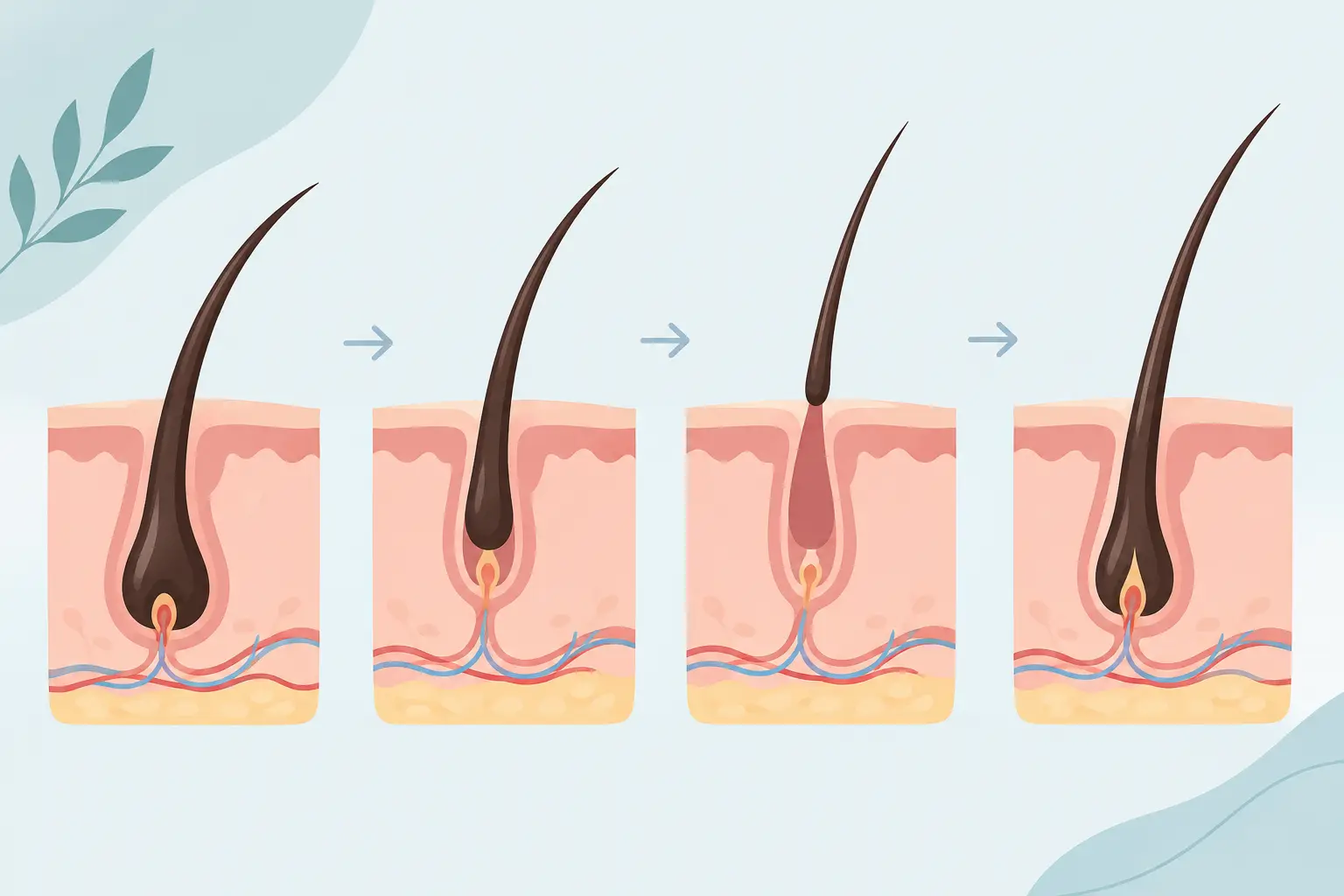
A healthy scalp contains follicles at different stages at the same time. This staggered pattern prevents all hairs from falling out together. The cycle has four recognized phases: anagen, catagen, telogen, and exogen. The first three describe the follicle’s biological state, while exogen refers to the release of the old hair fiber.
The cycle is influenced by genetics, hormones, age, nutrition, stress, illness, medications, scalp inflammation, and certain hairstyles or chemical treatments. That is why two people can have similar amounts of shedding but very different underlying causes and treatment needs.
Anagen: the active growth phase
Anagen is the stage most people associate with healthy hair growth. During this phase, cells in the hair bulb divide quickly and build the hair shaft. The follicle is firmly anchored in the skin, nourished by its blood supply, and actively producing pigment and keratin.
Scalp hair can remain in anagen for roughly two to seven years, sometimes longer. The longer a follicle stays in this phase, the longer that individual hair can grow. This is one reason some people can grow very long hair while others reach a shorter natural length even with excellent care.
At any given time, most healthy scalp hairs are in anagen. In androgenetic hair loss, commonly known as male or female pattern hair loss, the growth phase becomes progressively shorter in genetically sensitive follicles. The follicle may still make hair, but each new strand can emerge thinner, shorter, and less pigmented than the one before it.
Catagen: the controlled transition
Catagen is a brief transition phase, usually lasting only a few weeks. The follicle stops active production, the lower portion of the follicle regresses, and the hair bulb detaches from its blood supply. This is a normal, programmed part of the cycle, not a sign that the follicle has died.
Only a small percentage of scalp hairs are in catagen at one time. The hair shaft remains in place, but the follicle is preparing for a resting period. Because catagen is short and largely invisible from the outside, patients rarely notice it directly.
Telogen: the resting phase
In telogen, the follicle rests while the old hair remains loosely held in the scalp. This phase generally lasts around two to four months. A healthy amount of telogen hair is expected, and it creates the normal background shedding that occurs during washing, brushing, and daily life.
Problems arise when an unusually high number of follicles enter telogen simultaneously. This can happen after a major illness, fever, childbirth, rapid weight change, severe emotional stress, surgery, iron deficiency, thyroid imbalance, or certain medications. The result may be diffuse shedding across the scalp, often becoming noticeable several months after the triggering event.
This pattern, called telogen effluvium, can be temporary when the trigger is identified and resolved. However, it can also expose underlying genetic thinning that was previously less visible. A professional evaluation is valuable because the same complaint – “my hair is falling out” – can reflect very different follicle behavior.
Exogen: when the old strand sheds
Exogen is the shedding phase. The old club hair is released from the follicle, often while a new anagen hair is beginning to form underneath. Seeing shed hairs does not mean the follicle is gone. In a functioning cycle, the follicle remains alive and is preparing to produce another strand.
Most people shed somewhere around 50 to 100 hairs a day, although counting individual hairs is rarely useful. The more meaningful question is whether replacement hairs are growing back with the same thickness and whether overall density is changing over time.
When the Cycle Changes: Shedding vs. Miniaturization
Normal shedding is a cycle event. Pattern hair loss is a follicle-quality event. This distinction matters when choosing the right response.
With androgenetic hair loss, follicles in certain scalp zones are sensitive to dihydrotestosterone, or DHT. Over repeated cycles, affected follicles miniaturize. Their anagen phase shortens, the resting interval may become proportionally longer, and each new hair shaft becomes narrower. The visible result can be a receding hairline, widening part, diffuse thinning, or reduced crown density.
Miniaturization does not happen overnight. It is a gradual process, which is why early assessment can preserve more options. A follicle that is producing fine hair may still be active and potentially responsive to medically appropriate treatment. A follicle that has been inactive for a prolonged period may not produce meaningful coverage without surgical restoration.
This is also why shampoos alone rarely reverse established genetic thinning. A good scalp-care routine can support hair quality and comfort, but it cannot reliably change the biology of severely miniaturized follicles. Effective planning depends on the diagnosis, the degree of miniaturization, donor hair quality, family history, and the patient’s aesthetic goals.
Why Follicle Health Matters Before a Hair Transplant
A hair transplant does not create new follicles. It redistributes genetically resilient follicles, usually from the donor area at the back and sides of the scalp, into areas affected by hair loss. Those transplanted follicles retain many of their donor-area characteristics and, once established, can continue their own growth cycle in the recipient area.
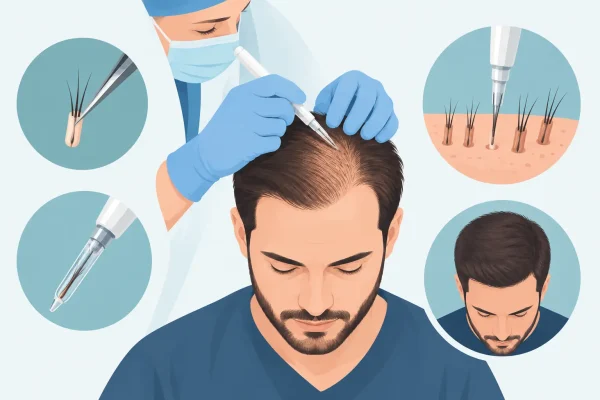
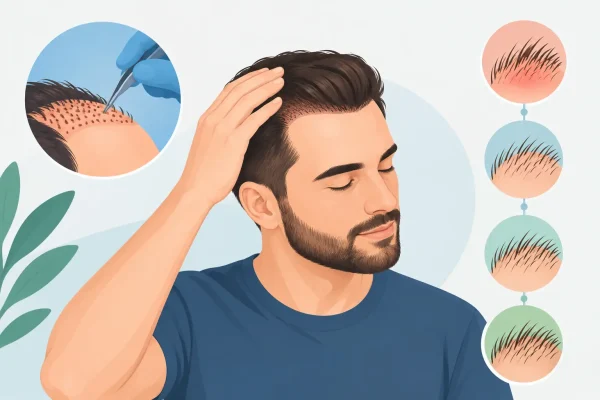
After FUE, Sapphire FUE, or DHI transplantation, the newly placed hairs typically shed within the first weeks. This can worry patients, but it is a common part of the post-procedure cycle. The follicles remain beneath the skin and enter a temporary resting stage before new growth begins. Early regrowth often starts around three to four months, with progressive improvement through the following months. Final maturation takes time because new hairs must lengthen, thicken, and synchronize naturally with the surrounding hair.
The trade-off is clear: transplantation can restore areas where follicles no longer produce adequate hair, but it does not stop future thinning in non-transplanted, genetically sensitive hair. A responsible surgical plan protects the donor area, designs a natural age-appropriate hairline, and considers long-term hair loss rather than pursuing aggressive density in a single session.
A More Precise Way to Assess Your Hair Cycle
Visual inspection alone can miss early miniaturization or diffuse thinning. At HairNeva, physician-led evaluation can combine clinical examination with advanced imaging such as AI-supported HairMetrix analysis to measure density, shaft caliber, and patterns across different scalp zones. That information helps distinguish temporary shedding from progressive follicle miniaturization and supports a more personalized treatment recommendation.
For some patients, the best next step may be medical management or regenerative support aimed at improving the environment around existing follicles. For others, especially when stable hair loss has created visible gaps, carefully planned transplantation may offer the most reliable path to natural-looking density. Women, patients seeking unshaven procedures, and those with textured or Afro hair require added attention to hair characteristics, donor capacity, and aesthetic design.
Avoid assuming that every increase in shedding requires surgery, or that every thinning area can be restored with non-surgical care. The right approach depends on what the follicles are actually doing now and what they are likely to do over the years ahead.
If your hair looks less dense than it did six or twelve months ago, document the change with consistent photos and seek an assessment before making decisions based on advertising or fear. Understanding the follicle cycle turns a vague concern into a clearer clinical question – and that is the first step toward a plan that protects both your appearance and your confidence.