How Are Hair Grafts Implanted in a DHI Transplant?
Learn how hair grafts are implanted during a DHI hair transplant, from graft loading and angle control to healing and natural-looking results over time.
- How Are Hair Grafts Implanted During a DHI Hair Transplant?
- Why DHI Can Be Useful Around Existing Hair
- What Happens Immediately After Implantation?
- When Will the Implanted Hair Grow?
In this article6
A natural hair transplant is decided millimeter by millimeter. The direction of a single graft at the hairline, the depth at which it sits, and the spacing between neighboring follicles all affect whether your result looks refined or transplanted. Patients often ask, “how are hair grafts implanted during a DHI hair transplant?” The answer centers on a specialized implantation device and, more importantly, the clinical judgment behind every placement.
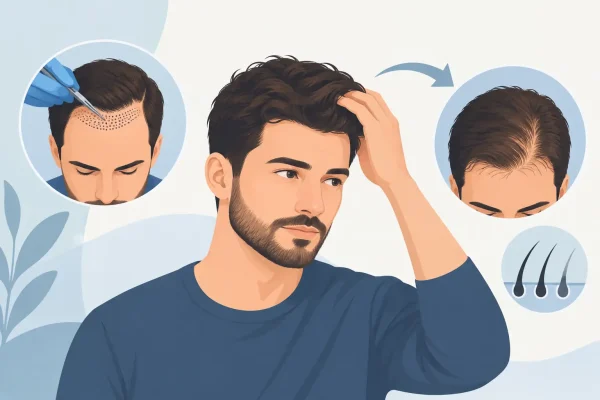
DHI, or Direct Hair Implantation, is designed to give the medical team close control over the placement of each extracted follicular unit. Rather than creating all recipient channels before placing grafts, the clinician can create the channel and implant the graft in a coordinated movement. For patients seeking a soft hairline, density between existing hairs, or a discreet restoration plan, that control can be particularly valuable.
How Are Hair Grafts Implanted During a DHI Hair Transplant?
A DHI procedure begins well before implantation. Your donor area, commonly the back and sides of the scalp, is assessed for graft quality, density, and long-term supply. The treatment plan also considers your facial proportions, age, hair characteristics, pattern of loss, and the likelihood of future thinning. A conservative, medically appropriate design is usually more convincing over time than an overly low or dense hairline.
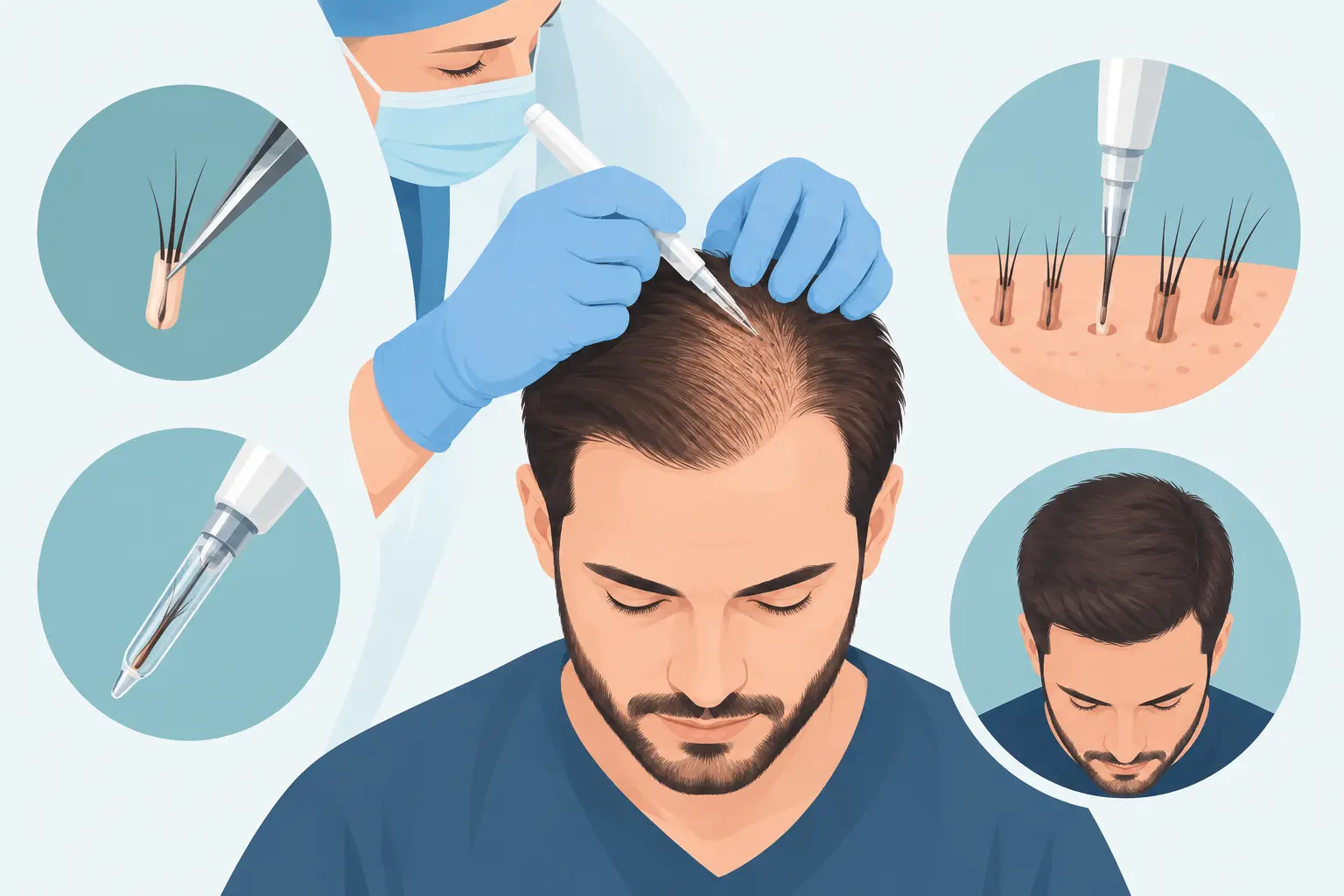
After local anesthesia, follicular units are extracted individually, typically using a precise motorized punch. Each graft may contain one, two, three, or occasionally more hairs. The team protects and sorts the grafts carefully during this stage. Single-hair grafts are often reserved for the leading edge of a hairline, while multi-hair grafts may help build density behind it.
The grafts are then loaded into a DHI implanter, often called a Choi pen. This pen has a fine hollow needle and a controlled plunger mechanism. A trained team member loads the follicular unit into the device without crushing or drying the delicate tissue. Proper handling matters: grafts spend time outside the body during every transplant, so temperature control, hydration, organization, and efficient workflow are not minor details.
Once loaded, the implanter tip is positioned at the planned recipient site. The clinician places it at a precise angle and depth, gently creates a channel with the needle tip, and releases the graft into that channel. In practical terms, channel creation and graft placement occur in the same controlled sequence. This is the feature that distinguishes DHI implantation from approaches in which channels are made first and grafts are later placed with forceps.
That does not mean the device alone creates a natural result. The implanter is a tool. A successful outcome depends on the skill of the physician and implantation team in choosing the right graft for the right location and reproducing the way hair naturally grows across different parts of the scalp.
Angle, Direction, Depth, and Distribution
The most visible part of implantation is the hairline, where technical precision is least forgiving. Natural frontal hairs usually exit the scalp at a shallow angle and do not grow in a perfectly straight line. They vary subtly in direction and spacing. An experienced clinician uses fine single-hair grafts, irregular micro-patterns, and carefully planned angulation to avoid a harsh, plug-like appearance.
Behind the hairline, placement changes. The midscalp often requires a balance between coverage and density, while the crown has a spiral pattern that must be respected. Grafts placed too upright can look unnatural and may provide less visual coverage. Grafts placed too close together may affect circulation or place unnecessary stress on the recipient area. If they are too sparse, the result may not meet the patient’s expectations. This is why graft numbers alone do not define quality.
Depth is equally significant. A graft implanted too shallowly can be vulnerable to displacement or poor positioning. Too deep, and it may not sit naturally within the skin. The goal is to position every follicular unit securely while maintaining the surrounding tissue environment needed for healing and growth.
Why DHI Can Be Useful Around Existing Hair
DHI is frequently considered for patients with thinning rather than complete baldness, including women with diffuse thinning and men seeking to strengthen the hairline or midscalp. Because implantation is highly controlled, it can be useful when grafts must be placed between existing hairs.
There is still an important limitation: native hairs affected by progressive androgenetic hair loss may continue to thin over time. A transplant redistributes permanent donor hair; it does not stop the underlying process. Your physician may discuss a long-term maintenance strategy, which can include medical therapies when appropriate, to help protect surrounding native hair.
DHI may also suit patients interested in an unshaven or minimally shaved approach. Whether this is feasible depends on hair length, the number of grafts needed, the donor area, and the treatment plan. It is not automatically the best choice for every patient, especially when a large session is required. The right technique should follow your clinical needs, not a marketing label.
What Happens Immediately After Implantation?
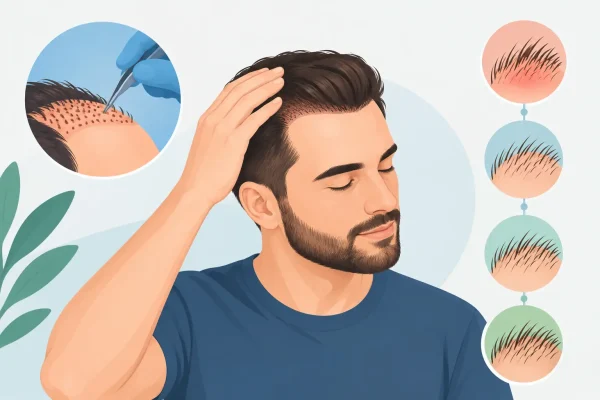
Once graft placement is complete, the implanted follicles are delicate but secured in their recipient sites. The first several days are focused on protecting them from friction, pressure, and accidental trauma. Patients receive individualized aftercare instructions covering washing, sleeping position, activity, and travel.
Small scabs around the transplanted area are expected. They typically loosen during the washing process over the following days, according to the clinic’s instructions. Mild redness or swelling can also occur, particularly around the forehead. These effects are temporary for most patients, but recovery varies with skin type, procedure size, and individual healing.
Avoid touching, scratching, or picking at the recipient area. Intense exercise, direct sun exposure, swimming, alcohol, and smoking may also need to be limited for a prescribed period. International patients should plan their travel carefully so they can attend the first wash and receive clear guidance before flying home.
When Will the Implanted Hair Grow?
The visible timeline requires patience. Implanted shafts commonly shed in the first weeks after surgery. This can be unsettling, but it is a normal phase known as shock shedding. The follicles remain under the skin and begin their new growth cycle afterward.
Early new growth may appear around three to four months, often fine and uneven at first. Noticeable improvement is commonly seen between six and nine months. Hair caliber, density, and texture continue to mature over 12 months, and crown areas may take longer. Results depend on graft survival, donor quality, scalp characteristics, postoperative care, and the progression of any ongoing hair loss.
At HairNeva, surgeon-led planning is designed around this long view. Advanced analysis and aesthetic judgment help determine not only where hair can be placed today, but how the result can continue to look proportionate as you age.
Questions to Ask Before Choosing DHI
A consultation should go beyond asking how many grafts you can receive. Ask who designs the hairline, who performs extraction and implantation, how grafts are preserved, and what technique is recommended for your specific pattern of loss. You should also ask what a realistic density outcome looks like with your donor supply.
Be cautious of promises of maximum density, guaranteed outcomes without qualification, or a one-technique-fits-all recommendation. DHI can be an excellent option, but FUE or Sapphire FUE may be more suitable in some cases. A responsible treatment plan explains the trade-offs clearly, including the possibility that a future session may be needed.
The best DHI result is rarely the one that draws attention immediately after it grows. It is the one that belongs to your face, follows your natural hair pattern, and lets you move through the world with greater confidence without anyone needing to know why.