Female Hair Transplant Guide for Natural Results
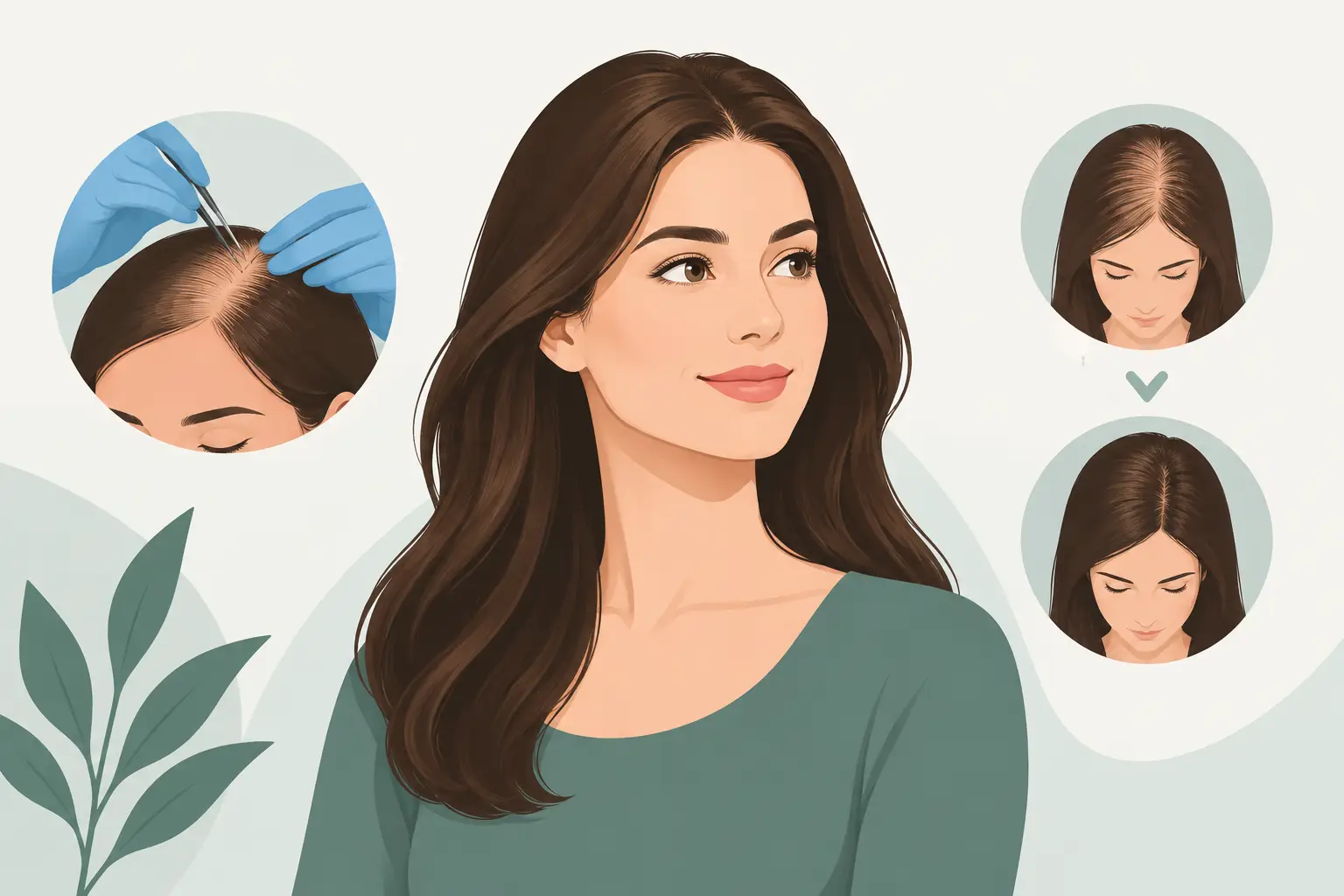
Female hair transplant guide: candidacy, FUE and DHI, recovery, and surgeon-led planning for natural density and long-term confidence.
- What Makes Female Hair Loss Different?
- Who Is a Good Candidate for a Female Hair Transplant?
- Female Hair Transplant Guide: Choosing the Right Method
- A Natural Hairline Is an Aesthetic Design, Not a Template
In this article7
- What Makes Female Hair Loss Different?
- Who Is a Good Candidate for a Female Hair Transplant?
- Female Hair Transplant Guide: Choosing the Right Method
- A Natural Hairline Is an Aesthetic Design, Not a Template
- What the Procedure and Recovery Usually Involve
- Protecting Your Result Over Time
- Questions Worth Asking at Your Consultation
A widening part, a more visible scalp under office lighting, or a hairline that no longer frames the face the same way can feel deeply personal. This female hair transplant guide is designed to replace uncertainty with a clear, medically grounded view of what treatment can achieve, who may be a candidate, and why individualized planning matters more than simply placing the highest possible number of grafts.
For many women, hair restoration is not about changing their appearance. It is about restoring the density, balance, and freedom to wear their hair with confidence again. The best outcomes look unremarkable in the best sense: hair that belongs to your face, grows in the right direction, and holds up naturally in real life.
What Makes Female Hair Loss Different?
Female hair loss does not always follow the familiar pattern of a receding hairline and bald crown. It often presents as diffuse thinning across the top of the scalp, widening at the part line, reduced ponytail volume, or gradual loss of density around the temples. Some women experience traction-related thinning from tight styles, while others have scarring conditions, hormonal shifts, nutritional deficiencies, thyroid concerns, autoimmune disease, or genetic female pattern hair loss.
This distinction changes the transplant conversation. A woman with a stable, localized area of loss and a strong donor area may be an excellent candidate. A woman with active diffuse thinning throughout the scalp may need medical treatment, monitoring, or a more conservative surgical plan first. Transplanted hair is permanent only if the underlying scalp and donor supply are assessed responsibly.
That is why a credible consultation should look beyond photographs. A physician-led assessment evaluates the pattern and stability of loss, donor density, hair caliber, scalp health, family history, medications, styling practices, and the likelihood of future thinning. Advanced digital hair analysis can help measure miniaturization and density so the treatment plan is based on more than a visual estimate.
Who Is a Good Candidate for a Female Hair Transplant?
The strongest candidates typically have enough healthy, stable donor hair at the back and sides of the scalp and a clearly defined area where added density will make a meaningful aesthetic difference. Common indications include a naturally high hairline, temple recession, traction alopecia, a stable scar, localized thinning, and selected cases of female pattern hair loss.
Candidacy is not determined by age alone. It depends on whether the hair loss is understood and sufficiently stable. If shedding is recent, rapid, or unexplained, a careful medical workup should come before surgery. Blood testing or referral to a dermatologist may be appropriate when iron deficiency, thyroid dysfunction, hormonal changes, or inflammatory scalp disease is suspected.
A transplant may also be the wrong first step when donor hair is too fine or sparse, when the loss is actively progressing, or when a scarring alopecia has not been stabilized. This is not a failure of treatment. It is good medicine. A responsible clinic protects the long-term appearance of both the recipient area and the donor zone rather than promising density that the available graft supply cannot safely deliver.
Female Hair Transplant Guide: Choosing the Right Method
Most female hair transplant procedures use follicular unit extraction, or FUE. Individual follicular units are harvested from the donor area and placed into carefully created recipient sites. Because follicles are selected and implanted one by one, FUE can support detailed work along the hairline, temples, part line, and areas of scar tissue.
Sapphire FUE uses sapphire blades to create recipient channels with precision. This can be valuable when planning the angle, direction, and distribution of grafts, particularly where existing hair must be protected. The choice is not about a trendy instrument. It is about whether the technique helps the surgeon create a natural density pattern while respecting the scalp and surrounding native hair.
DHI, or direct hair implantation, may be considered for women who need refined placement between existing hairs or prefer a controlled implantation approach. With DHI, grafts are implanted using a specialized implanter pen. It can be a practical option for selected cases, but it is not automatically superior to FUE. Natural results depend far more on graft quality, recipient-site design, and the experience guiding the procedure than on a technique name alone.
For women who do not want a large visible shaved area, an unshaven or partially shaved approach may be possible. This option can offer discretion during recovery, especially for professionals or international patients planning a short time away from work. The trade-off is that unshaven procedures can take longer and may not suit every graft count or hair-loss pattern. Your surgeon should explain what is feasible without compromising precision or donor management.
A Natural Hairline Is an Aesthetic Design, Not a Template
Hairline restoration requires restraint. An overly low, straight, or dense front hairline may look artificial now and can become difficult to maintain if native hair continues to thin later. The goal is an age-appropriate design that complements facial proportions and leaves room for the future.
Fine, single-hair grafts are generally used at the leading edge to create softness. Behind that transition, naturally occurring groups of two or more hairs can build visual density. Equally important are the angles of placement. Hair that emerges too upright or points in the wrong direction can look noticeable even when the grafts survive well.
For diffuse thinning, the focus may be less on lowering the hairline and more on improving coverage through the frontal third or around the part. This work requires particular care because the surgeon is operating around existing hair. Proper spacing, controlled channel creation, and a realistic density plan help reduce the risk of shock loss, a temporary shedding of vulnerable native hairs after surgery.
What the Procedure and Recovery Usually Involve
A female hair transplant is usually performed under local anesthesia. The donor area is prepared, follicles are harvested, and grafts are placed according to the approved design. Depending on the number of grafts and method selected, the procedure can take several hours. The experience should be organized around comfort, sterile clinical protocols, and direct physician oversight of the critical surgical stages.
In the first days, tiny scabs and mild swelling can occur. Patients are given instructions on sleeping position, washing, medication, exercise restrictions, and protecting the grafts. Most visible scabbing resolves within roughly one to two weeks, although recovery varies.
The transplanted hairs commonly shed several weeks after the procedure. This expected phase can be emotionally difficult if it is not explained in advance, but the follicles remain beneath the skin. Early new growth often begins around three to four months, with more noticeable improvement developing between six and nine months. Final maturation can take 12 months or longer, especially in areas where fine texture and density need time to develop.
Protecting Your Result Over Time
Surgery redistributes resistant donor follicles. It does not stop the biological process affecting non-transplanted hair. When appropriate, a physician may recommend a long-term plan that includes topical or oral medical therapies, platelet-rich plasma, mesotherapy, laser-supported hair care, or regenerative options. The right combination depends on diagnosis, medical history, and tolerance for ongoing treatment.
This is especially relevant for women with genetic thinning. A beautifully transplanted hairline can still appear less dense if the hair behind it continues to miniaturize. Maintaining existing hair is often just as valuable as adding transplanted hair.
For international patients, the quality of aftercare matters before travel is booked. Ask how the clinic handles preoperative assessment, remote check-ins, postoperative washing guidance, follow-up photographs, and questions after you return home. At HairNeva, treatment planning is built around surgeon-led evaluation, advanced analysis, and aesthetic precision so international patients have a defined path before, during, and after their Istanbul visit.
Questions Worth Asking at Your Consultation
A productive consultation should leave you with specifics, not broad assurances. Ask what is causing your hair loss, whether it appears stable, how many grafts are realistically available, and what density can reasonably be achieved in one session. You should also understand who performs each stage of the procedure, whether shaving is necessary, what your recovery will look like, and how your existing hair will be protected.
Review before-and-after results that resemble your own hair type, hair color, degree of loss, and treatment goal. A result on thick, dark hair may not predict the outcome for someone with fine, light-colored hair and diffuse thinning. Credible planning acknowledges these differences rather than using a single promise for every patient.
The right female hair transplant plan should feel considered rather than rushed. When diagnosis, donor preservation, and artistic placement are treated with equal seriousness, the result can offer something far more valuable than a fuller hairline: the confidence to stop thinking about your hair every time you step into the light.