Turkey Hair Transplant Package: What It Should Include
A Turkey hair transplant package should offer more than a hotel. Learn what physician-led planning, safe surgery, aftercare, and clear pricing look like.
- What a Turkey Hair Transplant Package Should Cover
- Physician-Led Assessment Is the Foundation
- Package Travel Should Support Recovery, Not Distract From It
- Price Matters, but Graft Count Alone Does Not Define Value
In this article8
- What a Turkey Hair Transplant Package Should Cover
- Physician-Led Assessment Is the Foundation
- Ask who performs each stage
- Package Travel Should Support Recovery, Not Distract From It
- Price Matters, but Graft Count Alone Does Not Define Value
- Be cautious with guarantees
- Recovery Support Must Continue After You Return Home
- How to Choose With Confidence
A Turkey hair transplant package can look remarkably similar on paper from one clinic to the next: a procedure, hotel stay, airport transfers, and a few days in Istanbul. The difference that determines your experience and your result is not the transfer vehicle or the hotel category. It is who evaluates your hair loss, who performs the medical stages of surgery, how the hairline is designed, and what happens after you fly home.
For U.S. patients, a package should reduce the complexity of traveling for treatment without reducing the standard of medical care. It should give you a clear treatment plan, realistic expectations, transparent inclusions, and access to a team that understands natural-looking restoration for your hair type, age, and long-term goals.
What a Turkey Hair Transplant Package Should Cover
A well-designed package starts with clinical planning, not a price promotion. Before travel, the clinic should review clear photos or conduct a virtual consultation to assess your donor area, pattern of loss, existing hair caliber, and expectations for density. This early review helps determine whether surgery is appropriate now, how many grafts may be needed, and whether medical or regenerative support should be considered alongside transplantation.
The surgical portion should specify the technique recommended for you. FUE removes individual follicular units from the donor area, while Sapphire FUE uses sapphire blades to create recipient channels with controlled angle and direction. DHI places grafts using a specialized implanter pen and can be useful where precise placement or a discreet approach is a priority. None is automatically the best choice for every patient. The right method depends on the treatment area, hair characteristics, donor capacity, shaving preference, and the aesthetic plan.
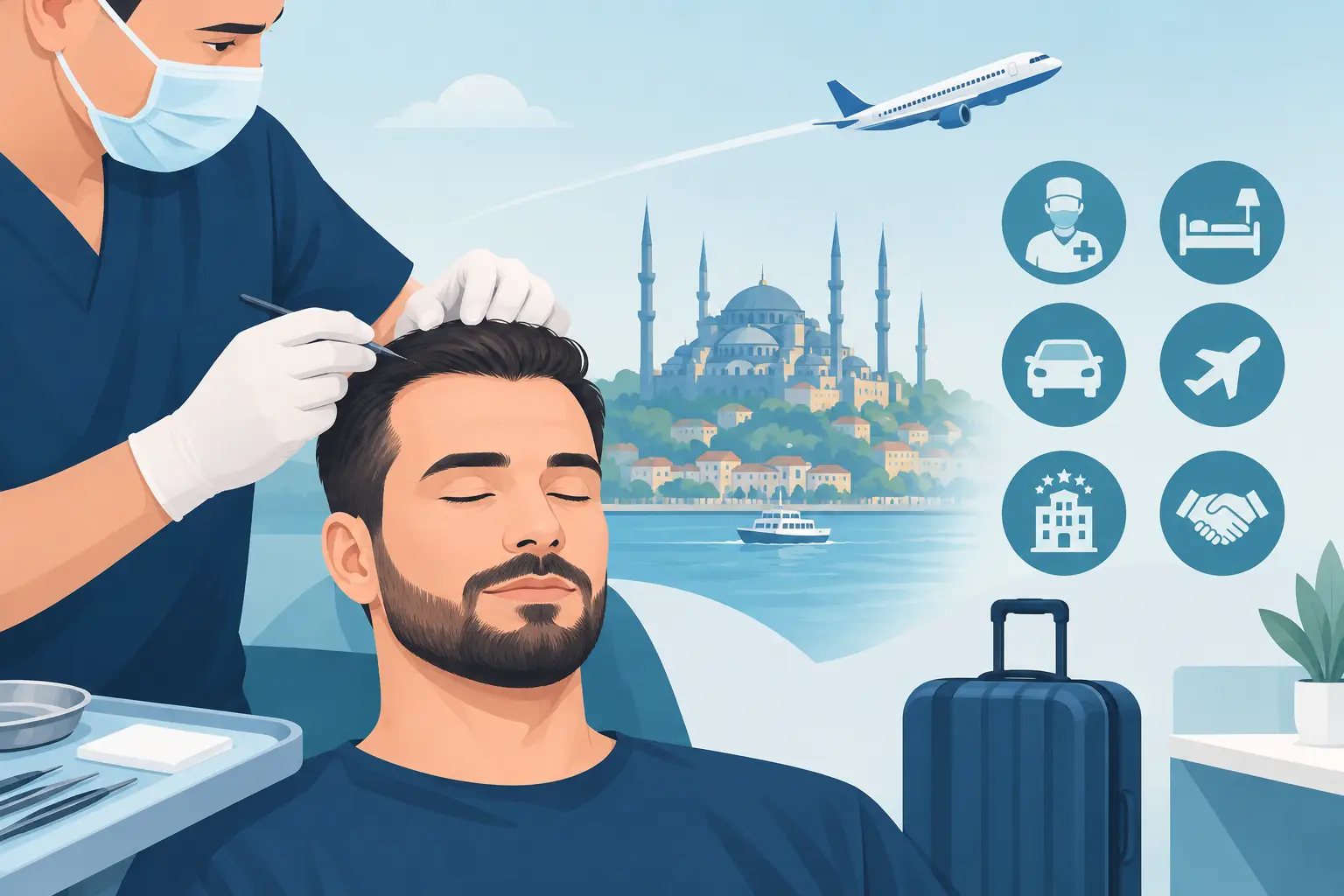
Your package should also clearly state what is included beyond the procedure itself. For international patients, that commonly means accommodation, private airport and clinic transfers, a translator or multilingual patient coordinator, prescribed post-procedure medications, aftercare products, and follow-up guidance. These details matter because they make the first recovery days calmer and more manageable.
Just as important is what is not included. Flights, additional medical tests, upgraded accommodations, companion costs, and extra treatments may sit outside the base price. A premium clinic should explain this before you commit, rather than presenting unexpected additions after your arrival.
Physician-Led Assessment Is the Foundation
Hair transplantation is an aesthetic medical procedure, not a standard cosmetic service. Grafts are limited, and a poor plan can overuse the donor area or create a hairline that looks unnatural as future hair loss progresses. The consultation must look beyond how many grafts can be placed in one day.
A physician-led assessment considers facial proportions, skin-to-hair contrast, curl pattern, density behind the hairline, and the likely evolution of hair loss. For a younger patient with a receding hairline, conservative design is often wiser than a low, dense line that may not age well. For women with diffuse thinning, the priority may be preserving existing hair and assessing the cause of loss before recommending surgery. Afro-textured hair and curly follicles also require specific extraction and implantation planning.
At HairNeva, treatment planning is supported by physician oversight and detailed hair analysis, including AI-powered HairMetrix assessment where appropriate. That level of evaluation helps turn a general request for “more density” into a plan built around measurable donor availability and an aesthetic outcome that fits the individual.
Ask who performs each stage
A reputable clinic should answer this directly. Ask who designs the hairline, administers anesthesia, extracts grafts, creates recipient channels, and supervises implantation. Titles can be confusing in medical tourism marketing, so clarity matters more than broad promises of a “doctor-led” package.
You should also ask about the number of patients treated on the same day. A high-volume schedule does not automatically mean poor care, but personal surgical attention, careful graft handling, and quality control are essential. You are choosing a team for a permanent aesthetic procedure, not simply reserving a treatment slot.
Package Travel Should Support Recovery, Not Distract From It
Most international patients arrive one or two days before surgery, then stay long enough for their first wash and postoperative review. The exact itinerary varies by procedure and travel schedule, but it should leave room for rest. Istanbul can be an exciting city, yet the days immediately after a transplant are not the time for long walks, crowded sightseeing, heat exposure, or late nights.
A useful package includes reliable airport transfers and accommodation close enough to the clinic to avoid a stressful commute. It should also provide practical pre-travel instructions. Patients should know when to stop alcohol, smoking, certain supplements, or blood-thinning medications if directed by their medical team. They should understand whether shaving is required and how to dress on procedure day, usually in a button-front shirt that does not touch the grafts.
If discretion is a priority, ask specifically about unshaven hair transplant options. These can preserve more of your existing hairstyle during recovery, although suitability depends on the area being treated and the number of grafts required. The convenience can be valuable for professionals, but it may also involve more technical planning and is not the ideal solution for every case.
Price Matters, but Graft Count Alone Does Not Define Value
A Turkey hair transplant package can be significantly more accessible than treatment in the United States, even when it includes travel support. However, comparing offers only by quoted graft count can lead patients toward the wrong decision.
A graft may contain one, two, three, or more hairs. More grafts are not necessarily better if the donor area is weak, the extraction is aggressive, or the placement pattern does not create natural coverage. Likewise, an unusually low price may reflect limited physician involvement, rushed sessions, generic hairline design, or omissions that become clear only after you arrive.
Instead, evaluate value through the total standard of care: consultation quality, surgeon involvement, technique selection, donor preservation, hygiene protocols, patient coordination, transparent pricing, and follow-up access. Before-and-after results should show a range of hair types and degrees of hair loss, not only a few highly favorable cases photographed under ideal lighting.
Be cautious with guarantees
Hair growth is biological and varies by person. No ethical provider can promise that every graft will grow at the same rate or that a specific density will be achieved. A lifetime hair transplant warranty certificate may offer additional reassurance about a clinic’s commitment to its work, but it should come with clear terms and should never replace a realistic medical discussion.
Recovery Support Must Continue After You Return Home
The operation is only one part of the process. In the first 10 to 14 days, patients need precise guidance on washing, sleeping position, sun protection, activity restrictions, and when it is safe to wear hats or resume exercise. Temporary scabbing and shedding are expected. Transplanted hairs often shed during the first several weeks before new growth begins.
Visible growth commonly starts around the third or fourth month, with progressive improvement over subsequent months. Final maturation may take 12 months or longer, particularly for crown work. A clinic should prepare you for this timeline so normal shedding or slow early growth does not become unnecessary anxiety.
Ask how follow-up works across time zones. Can you send photographs? Is there a dedicated coordinator? Will a clinician review concerns such as persistent redness, swelling, or signs of infection? Strong aftercare is especially important for patients returning to the U.S., where an in-person visit to the Istanbul clinic is not immediately available.
How to Choose With Confidence
Before booking, request a written plan that identifies the proposed technique, estimated graft range, package inclusions, surgical team roles, recovery itinerary, and payment terms. Ask to see results that resemble your own hair characteristics and area of concern. If you are considering a beard or eyebrow transplant, make sure the clinic has experience with the different angles, density requirements, and facial design those procedures demand.
The best package is not necessarily the cheapest, the fastest, or the one that promises the highest graft number. It is the one that treats your donor hair as a finite resource, gives your appearance the care it deserves, and provides medical support from first consultation through long-term growth.
Choose a clinic that makes you feel informed rather than pressured. A thoughtful plan, clear answers, and a natural aesthetic vision are the details that can make your trip to Istanbul feel like the beginning of lasting confidence.