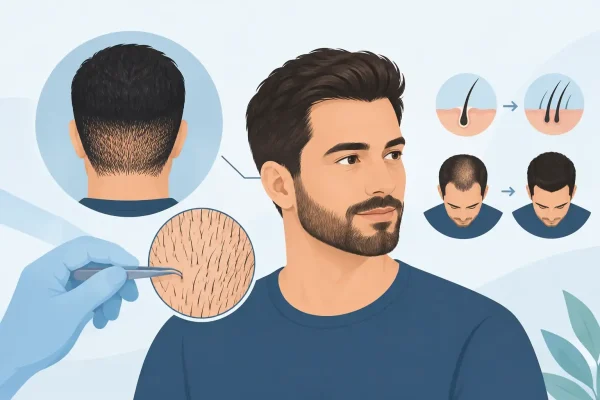
How Does Graft Placement Angle Affect Hair Growth?
How does graft placement angle affect hair growth? See how direction, depth, and density planning support a natural-looking, refined transplant result.
- How Does Graft Placement Angle Affect Hair Growth Results?
- The Right Angle Changes Across the Scalp
- Why Depth and Angle Must Be Planned Together
- Placement Angle and the Illusion of Density
In this article8
- How Does Graft Placement Angle Affect Hair Growth Results?
- Angle Is Different From Growth Rate
- The Right Angle Changes Across the Scalp
- Temple, Beard, and Eyebrow Angles Need Extra Precision
- Why Depth and Angle Must Be Planned Together
- Placement Angle and the Illusion of Density
- What Happens if Grafts Are Placed at the Wrong Angle?
- What Patients Can Do Before and After Surgery
A transplant can achieve strong graft survival and still look unnatural if the implanted hairs point in the wrong direction. This is why patients often ask, “how does graft placement angle affect hair growth?” The short answer is that angle does not change the follicle’s genetic ability to grow, but it has a major effect on how the new hair exits the scalp, blends with surrounding hair, creates visual density, and matures into a convincing result.
For a natural-looking hair transplant, every graft must be positioned with purpose. The surgeon and implantation team consider the angle of the hair shaft, the direction of neighboring hairs, the area of the scalp being restored, and the patient’s natural styling habits. It is technical work, but its impact is highly visible.
How Does Graft Placement Angle Affect Hair Growth Results?
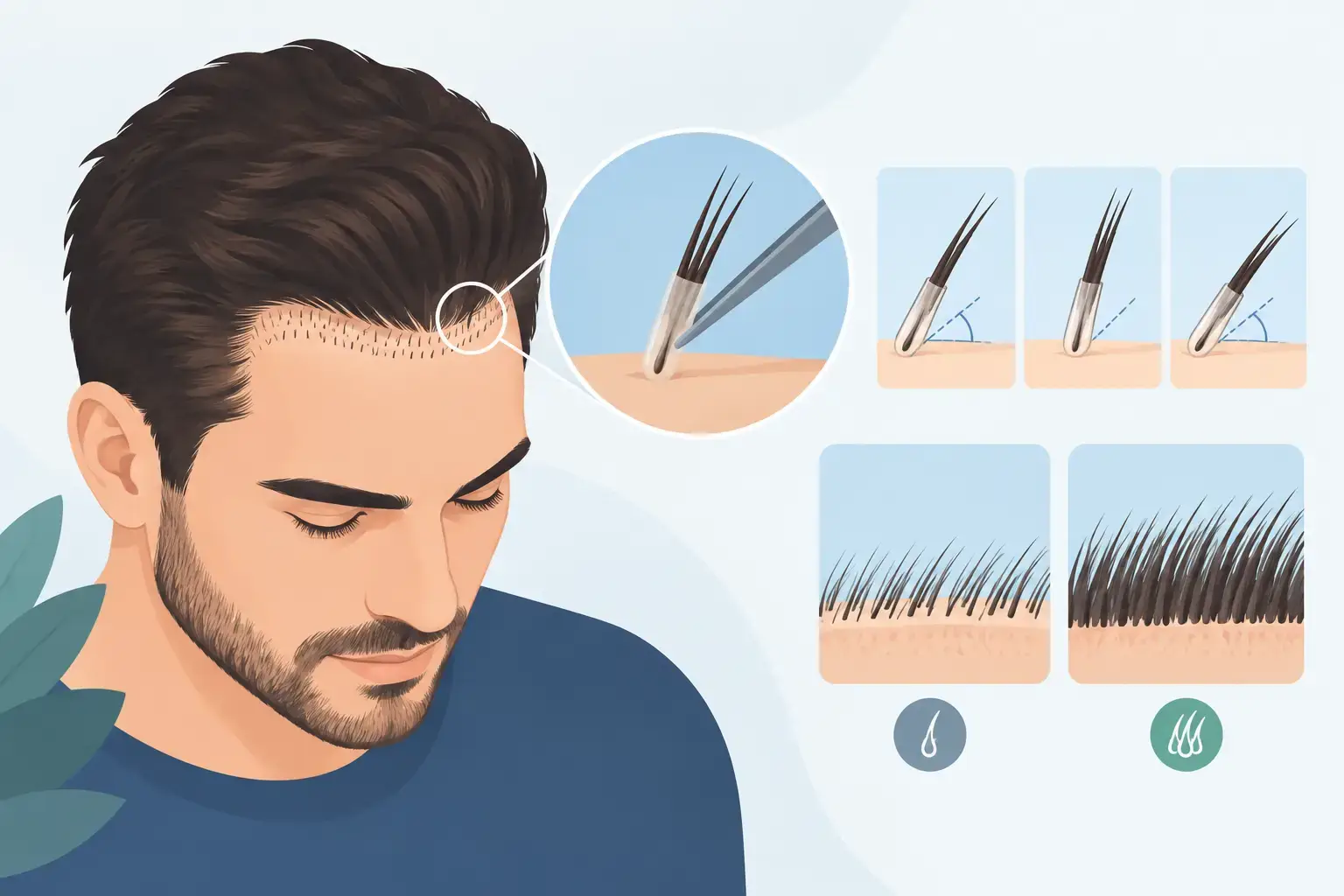
Hair follicles grow in the direction in which they are placed. Once a graft heals and enters its growth cycle, its hair shaft emerges from the skin following the orientation established during implantation. A graft placed too upright may grow well, yet stand away from the scalp and draw attention to the transplant. A graft placed at a shallow, natural angle is more likely to lie flat and merge with existing hair.
Angle also changes the way light reflects across the scalp. Hair that lies close to the skin can cover more surface area, helping create the appearance of density. More vertical hairs expose more scalp between shafts, which can make a transplanted area appear thinner even when the same number of grafts has survived.
This distinction matters because successful restoration is not simply a graft-count calculation. Naturalness comes from matching the existing hair pattern with precision. The goal is hair that looks like it has always belonged there, whether it is worn short, styled back, parted, or viewed in bright overhead light.
Angle Is Different From Growth Rate
A properly implanted follicle will follow its normal biological cycle regardless of whether it is placed at a shallow or steep angle. Most transplanted hairs shed in the early weeks after surgery, then begin to regrow over the following months. Placement angle does not make follicles grow faster or slower.
What it does affect is the cosmetic quality of that growth. If an angle is poorly matched, the hair may grow outward, cross over adjacent hairs, resist styling, or look plug-like at the hairline. Correcting an unnatural angle can be more challenging than treating simple thinning, which is why surgical planning should begin long before implantation day.
The Right Angle Changes Across the Scalp
There is no single “correct” graft angle for every zone. Natural hair does not emerge from the scalp at one uniform position. It changes gradually across the hairline, temples, frontal zone, midscalp, crown, beard, and eyebrows.
At the frontal hairline, hairs typically exit at a very acute angle and lie close to the forehead. This delicate transition is essential. A steeply placed frontal graft can create a bristled appearance, especially when a patient wears shorter hair or exposes the hairline. Fine, single-hair grafts placed at carefully controlled angles help create softness and irregularity that resemble natural hair growth.
Behind the hairline, the angle can become slightly more elevated while still following the patient’s native pattern. This allows the frontal zone to build coverage without creating a visible wall of hair. In the midscalp, grafts need to continue the flow from the front, so that styling feels intuitive rather than forced.
The crown requires another level of expertise. Crown hair follows a spiral or whorl pattern, often changing direction multiple times within a small area. Grafts placed without respect for this pattern can grow in conflicting directions and make the swirl look artificial. A surgeon must map the existing whorl carefully, especially when native hair remains around it.
Temple, Beard, and Eyebrow Angles Need Extra Precision
Temple points are among the most refined areas in hair restoration. The hairs are naturally fine, flat, and angled backward toward the scalp. An overly dense or upright temple transplant can look immediately out of place.
Beard restoration also demands attention to angle and direction. Facial hair changes its flow across the cheeks, jawline, mustache, and chin. Grafts must follow these shifts so the beard can be trimmed and styled naturally. In eyebrow transplantation, follicles need to lie exceptionally flat to the skin and follow the characteristic rise, arch, and tail of each brow. Even a healthy graft can be disappointing if it grows at the wrong angle.
Why Depth and Angle Must Be Planned Together
Angle cannot be separated from implantation depth. A graft inserted too shallowly may be unstable, more exposed, or more vulnerable to drying and trauma. One placed too deeply may heal with an uneven surface appearance or compromise optimal positioning. The recipient site must be created at the proper depth, width, and angle for each individual graft.
The challenge is to protect the follicle while recreating natural anatomy. This is particularly relevant with FUE and Sapphire FUE techniques, where individual grafts are extracted and implanted with close attention to recipient-site design. In DHI procedures, implanter pens can support controlled placement, but the final result still depends on the clinician’s judgment and technique. A tool does not replace artistic planning or surgical experience.
At HairNeva, physician-led planning focuses on the patient’s facial proportions, donor capacity, hair caliber, curl pattern, existing growth direction, and long-term hair loss risk. This approach helps avoid a design that looks dense only in photographs but fails to age naturally over time.
Placement Angle and the Illusion of Density
Many patients assume more grafts are always the answer to better coverage. In reality, thoughtful angulation can improve the visual impact of each graft. When hairs are positioned to overlap and lie naturally with surrounding strands, they can create a fuller appearance without overusing the donor area.
This is especially valuable for patients with limited donor supply, fine hair, diffuse thinning, or advanced hair loss. The surgeon must balance density goals with donor preservation. Packing grafts too densely or at inappropriate angles can increase trauma to the recipient area and leave little flexibility for future treatment.
Hair texture also influences the strategy. Curly or wavy hair can create more visual coverage than straight, fine hair, but it may require special attention during extraction and implantation because the follicle path beneath the skin is less predictable. Afro-textured hair transplant procedures require experienced handling to preserve graft integrity while maintaining a realistic curl pattern and direction after growth.
What Happens if Grafts Are Placed at the Wrong Angle?
Poor angulation does not always mean graft failure. The follicles may survive and grow, but the aesthetic result can be compromised. Common concerns include hairs that stick straight up at the hairline, an unnatural “doll hair” effect, visible scalp despite a high graft count, or crown hairs that disrupt the native whorl.
Some patients may be able to improve mild direction issues through styling, hair length, or selective trimming. More pronounced problems may require revision work, which can involve removing misplaced grafts, repositioning them, or adding carefully placed grafts to soften the area. Revision surgery requires conservative judgment because donor hair is finite.
The best protection is choosing a clinic that treats graft placement as both a medical and aesthetic procedure. Before surgery, patients should expect a detailed assessment of their hair loss pattern and a design conversation that addresses not only the number of grafts, but also hairline shape, direction, density distribution, and future expectations.
What Patients Can Do Before and After Surgery
Before treatment, share how you normally wear your hair. Bring photographs from periods when your hair was fuller if they show your natural hairline, crown pattern, beard shape, or eyebrow form. These details give the medical team a clearer reference for recreating your individual look.
After surgery, follow all washing and recovery instructions closely. Grafts are most vulnerable during the early healing period, when rubbing, scratching, pressure, or accidental trauma can affect their stability. Once the grafts are secure, the angle established during surgery remains part of their long-term growth pattern.
Patience is equally important. Early shedding can be unsettling, but it is a normal part of the process for many patients. New growth usually begins gradually, and refinement continues for several months as hairs thicken, lengthen, and settle into their natural direction.
A natural transplant is built one graft at a time. The most reassuring results come from precise placement that respects how your own hair grows, so the outcome supports not only fuller coverage, but the confidence to wear it any way you choose.