What Is the Role of the Scalp’s Blood Supply in Hair Growth?

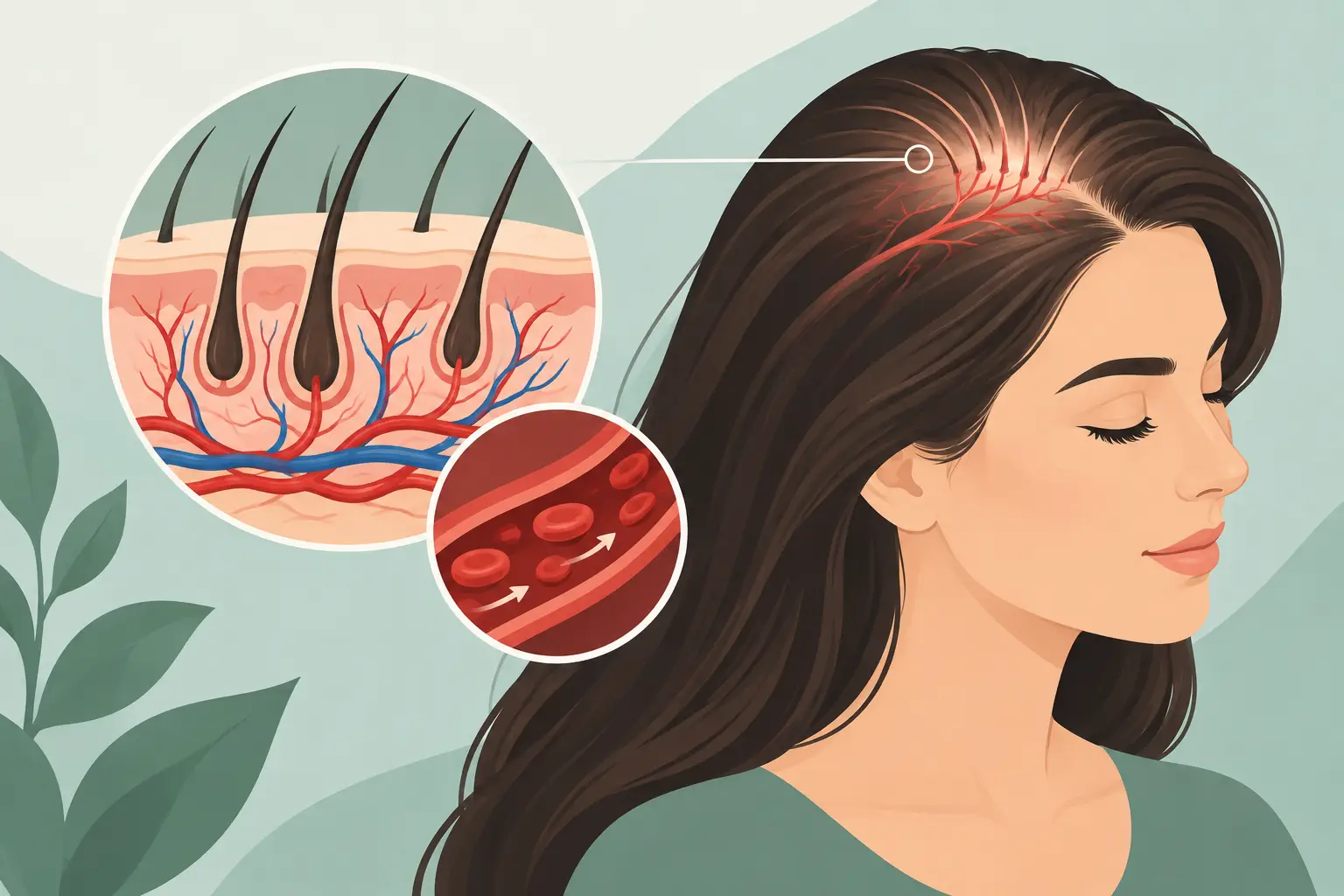
What is the role of the scalp's blood supply in hair growth? Learn how circulation supports follicles, hair loss care, and transplant recovery planning.
- How the Scalp’s Blood Supply Supports Hair Growth
- Does Poor Scalp Circulation Cause Hair Loss?
- Blood Supply and Hair Transplant Survival
- Can Scalp Massage Improve Blood Flow?
In this article8
- How the Scalp’s Blood Supply Supports Hair Growth
- Why the hair bulb needs consistent circulation
- Does Poor Scalp Circulation Cause Hair Loss?
- Blood Supply and Hair Transplant Survival
- The donor area matters too
- Can Scalp Massage Improve Blood Flow?
- Supporting a Healthy Scalp Environment
- When to Seek a Hair Loss Evaluation
A healthy hair follicle is not an isolated structure. It is a living mini-organ that depends on a fine network of blood vessels beneath the scalp to receive oxygen, glucose, amino acids, vitamins, and hormonal signals. So, what is the role of the scalp’s blood supply in hair growth? It creates the biological conditions that allow follicles to produce hair efficiently, cycle normally, and recover after stress or treatment.
For people noticing thinning, a receding hairline, or slower growth, circulation is worth understanding. But it is only one piece of a much larger picture. Better scalp blood flow cannot reverse every form of hair loss, particularly genetic pattern hair loss. A precise medical assessment is what separates useful treatment planning from expensive guesswork.
How the Scalp’s Blood Supply Supports Hair Growth
Each follicle is supplied by tiny blood vessels around its base, in an area called the dermal papilla. During the active growth phase, known as anagen, these vessels deliver the nutrients and oxygen needed for rapidly dividing hair-producing cells. The follicle uses that energy to build the keratin fiber that becomes the visible hair shaft.
Blood flow also helps remove cellular waste and carries signaling molecules that influence the hair cycle. When the local environment around a follicle is healthy, the follicle is better positioned to remain in the anagen phase for longer and produce a thicker, more resilient strand.
This does not mean that hair grows simply because more blood reaches the scalp. Hair growth is regulated by genetics, hormones, immune activity, nutrition, age, inflammation, and the condition of the follicle itself. Circulation supports follicle function, but it does not override the underlying cause of hair loss.
Why the hair bulb needs consistent circulation
The visible part of a hair is biologically inactive, which is why oils, shampoos, and surface treatments cannot change its growth once it has emerged. The active work happens below the skin, at the hair bulb. This is where cells multiply quickly and require a consistent supply of oxygen and nutrients.
A compromised local environment may contribute to weaker growth, increased shedding, or slower recovery from scalp irritation. Severe systemic conditions that affect circulation, oxygen delivery, or nutrition can sometimes be reflected in the hair. However, in many cases of gradual thinning, especially at the temples, crown, or part line, the primary issue is follicle miniaturization driven by genetic sensitivity to hormones rather than poor circulation alone.
Does Poor Scalp Circulation Cause Hair Loss?
Poor circulation is often discussed as if it is the hidden explanation for every thinning pattern. That is too simple. In androgenetic alopecia, the most common form of hair loss in men and women, susceptible follicles progressively shrink under the influence of dihydrotestosterone, or DHT. The hairs become finer, shorter, and less visible over time.
Changes in the blood vessels around miniaturizing follicles may occur, but they are not generally considered the single cause of genetic hair loss. Trying to solve a hereditary pattern with scalp massage alone can delay more effective care.
That said, scalp and overall vascular health still matter. Smoking, uncontrolled diabetes, certain inflammatory scalp conditions, poor nutrition, severe stress, and some medical conditions may affect tissue health and healing. They can also influence how the scalp responds to restorative treatments. A clinician should evaluate sudden shedding, patchy hair loss, itching, pain, scaling, or hair loss accompanied by fatigue or other systemic symptoms, as these signs may point to a condition beyond routine pattern thinning.
Blood Supply and Hair Transplant Survival
The scalp’s blood supply becomes especially relevant during hair transplantation. A transplant is not just a matter of moving grafts from the donor area to thinning areas. Each graft must be placed at the correct depth, angle, and density while respecting the recipient area’s existing circulation.
In FUE, Sapphire FUE, and DHI procedures, follicular units are carefully extracted from the donor area and implanted into recipient channels or sites. In the first days after placement, grafts rely on diffusion of oxygen and nutrients from the surrounding tissue. They then establish a new blood supply through a normal healing process called revascularization.
This is why surgical planning matters. Packing too many grafts into a small area without respecting tissue limits can place unnecessary stress on the recipient scalp. A surgeon-led approach balances the desire for visible density with graft survival, scalp safety, and a natural result that still looks believable years later.
The donor area matters too
A healthy donor area needs careful management because extraction sites must heal well and retain a natural appearance. Factors such as smoking, poorly controlled blood sugar, prior scalp scarring, active inflammation, and certain medications may affect healing or require a tailored plan.
For international patients, an honest preoperative consultation is particularly valuable. High-resolution scalp assessment, medical history, donor evaluation, and realistic density planning can identify risks before travel. At HairNeva, this level of planning is central to creating a result that respects both facial aesthetics and long-term donor preservation.
Can Scalp Massage Improve Blood Flow?
Scalp massage may temporarily increase local blood flow and can feel relaxing, especially when performed gently. It may also help some people become more consistent with their scalp-care routine. But it should be viewed as supportive care, not a stand-alone treatment for established genetic hair loss.
Aggressive rubbing, scratching, or using excessive pressure can irritate an already sensitive scalp. This is particularly relevant after a hair transplant, when newly placed grafts need protection. Follow the clinic’s aftercare instructions closely and avoid any massage until your surgeon confirms it is safe.
Low-level laser therapy is another approach sometimes used to support hair care. Its proposed effects involve cellular activity and local circulation, but results vary between individuals and devices. It may be considered as part of a broader plan, not as a substitute for diagnosis, evidence-based medical care, or appropriately planned transplantation.
Supporting a Healthy Scalp Environment
A healthy circulation-friendly routine is usually uncomplicated. Avoid smoking, manage chronic health conditions with your physician, eat enough protein and iron-rich foods, stay hydrated, and address scalp inflammation rather than covering it up. Gentle cleansing is often more helpful than overly harsh products that leave the scalp dry or irritated.
It is also wise to be cautious with supplements marketed as circulation boosters or miracle growth solutions. If iron deficiency, thyroid disease, vitamin deficiency, or another medical issue is suspected, testing should guide treatment. Taking high-dose supplements without a demonstrated need can be ineffective and occasionally harmful.
For patients with progressive thinning, the most valuable step is determining whether follicles are still active and salvageable, or whether an area has become sparse enough to benefit from surgical restoration. Advanced scalp analysis can help assess hair caliber, density, and the pattern of miniaturization, giving the treatment plan a much stronger clinical foundation.
When to Seek a Hair Loss Evaluation
A consultation is appropriate when shedding persists for several months, the hairline is visibly changing, the crown is becoming more apparent, or styling is no longer concealing low density. It is also advisable after a sudden shedding event, pregnancy-related shedding that does not improve, or unexplained patchy loss.
The right plan may involve monitoring, medical support, regenerative options where appropriate, or a hair transplant designed around your donor capacity and aesthetic goals. Not every patient needs surgery immediately, and not every form of hair loss should be transplanted. The best result begins with identifying what the follicles need now and protecting the options you may need later.
Your scalp’s blood supply is the quiet support system behind every healthy follicle. Give it the respect it deserves, but do not let a simplified circulation theory distract from a personalized diagnosis and a treatment plan built for lasting, natural-looking confidence.