Can You Get a Hair Transplant Without Shaving Your Head?
Can you get a hair transplant without shaving your head? Learn how unshaven FUE and DHI work, who qualifies, recovery realities, and what to expect first.
- Can You Get a Hair Transplant Without Shaving Your Head?
- What “Unshaven” Really Means in Practice
- Who Is a Good Candidate for an Unshaven Hair Transplant?
- Why Surgical Precision Matters More Than Discretion Alone
In this article7
- Can You Get a Hair Transplant Without Shaving Your Head?
- What “Unshaven” Really Means in Practice
- Who Is a Good Candidate for an Unshaven Hair Transplant?
- Why Surgical Precision Matters More Than Discretion Alone
- The Trade-Offs of an Unshaven Procedure
- What Recovery Looks Like When You Keep Your Hair Long
- Questions to Ask Before Choosing a No-Shave Option
A closely cropped donor area can be a concern long before a patient worries about discomfort. For professionals, public-facing people, and women with longer hair, the question is often very practical: can you get a hair transplant without shaving your head? In many cases, yes. An unshaven hair transplant can preserve your existing hairstyle and make the early recovery period considerably more discreet.
But “no-shave” does not mean every hair remains untouched, and it is not the right method for every pattern of hair loss. The best plan depends on your donor density, the number of grafts needed, your hair length and texture, and the natural-looking result you want to achieve.
Can You Get a Hair Transplant Without Shaving Your Head?
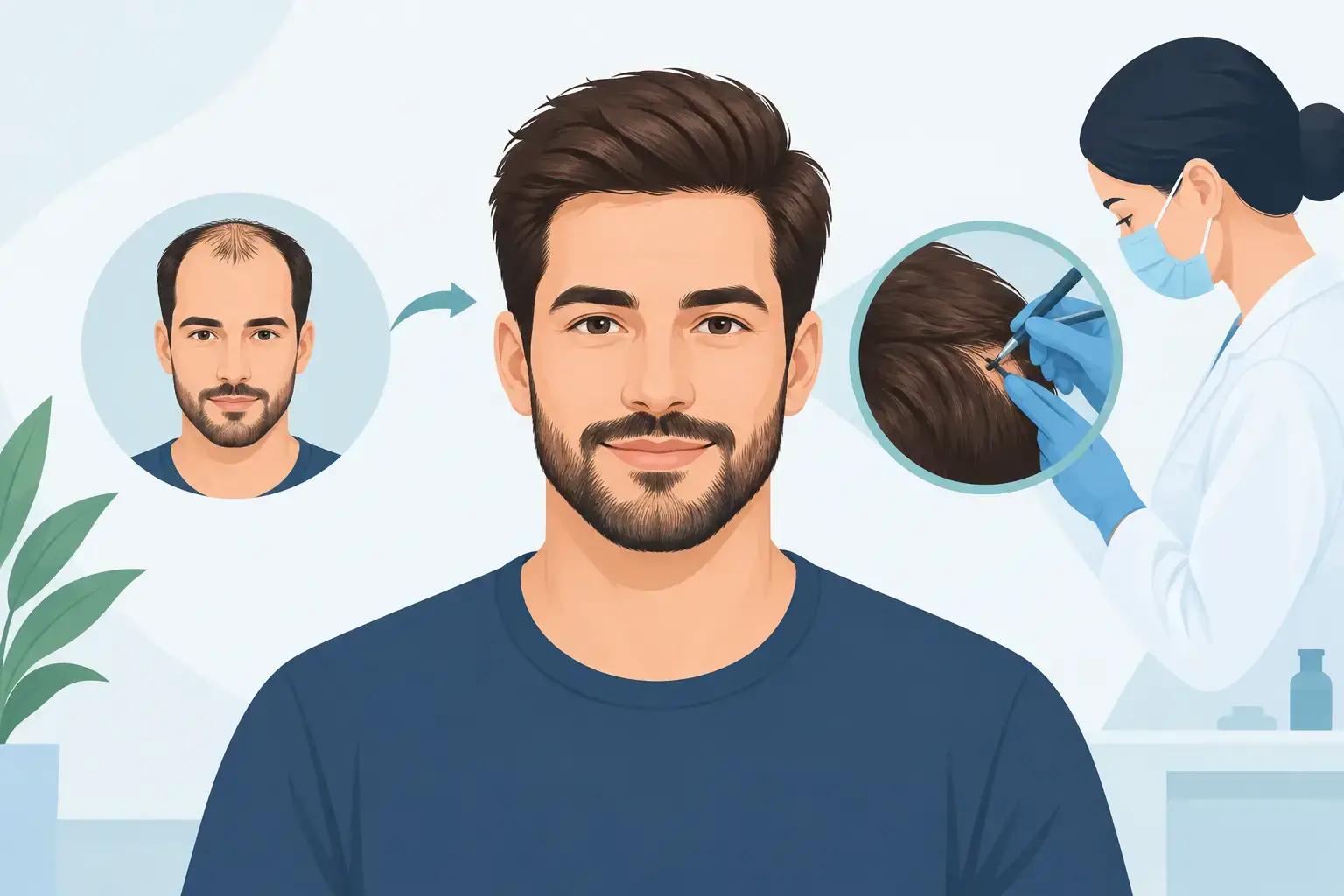
An unshaven hair transplant is a technique in which the visible hair on the scalp is largely kept at its existing length. Rather than shaving the full head, the surgical team selectively trims individual donor hairs or creates small concealed working areas beneath longer hair.
This approach is commonly performed with FUE, or follicular unit extraction. During FUE, individual follicular units are harvested from the donor zone, usually at the back and sides of the scalp, and placed into carefully designed recipient sites. With long-hair or unshaven FUE, grafts can be extracted one by one without a full shave.
DHI may also be used as part of an unshaven plan. DHI refers to an implantation method that uses a specialized implanter pen to place grafts. It can support precise placement between existing hairs, particularly in areas requiring controlled angle and direction. However, DHI itself does not automatically make a procedure unshaven. The deciding factor is the surgical plan, the amount of trimming required, and the technique chosen for extraction and implantation.
For many patients, the result is a more private experience. Existing hair can help cover minor redness or the small donor extraction points while they heal. That benefit is meaningful, but it should never take priority over graft quality, safety, or a thoughtful aesthetic design.
What “Unshaven” Really Means in Practice
The phrase can be misleading when it is presented as a guarantee of zero trimming. A responsible clinic will explain exactly what may need to be trimmed before surgery.
Some patients can keep nearly all of their hair long, with only individual donor follicles clipped. Others need a narrow horizontal strip or several small zones beneath the surrounding hair shortened for safe harvesting. The donor area is then covered by hair above it once you resume your normal styling.
The recipient area may also require selective trimming. This is especially common when placing grafts between existing hairs to improve density. Trimming a small number of hairs can give the surgeon clearer visibility and reduce the risk of damaging native follicles during implantation.
A fully unshaven procedure is usually most practical when the treatment area is limited, such as a mild receding hairline, temple restoration, a small crown refinement, or scar camouflage. A larger restoration requiring several thousand grafts may still be possible without shaving the entire head, but it becomes more technically demanding and may take longer. In some cases, a partially shaved approach provides better access and a more efficient route to the desired density.
Who Is a Good Candidate for an Unshaven Hair Transplant?
The strongest candidates typically have stable donor hair, a clear treatment goal, and enough existing length to conceal selectively trimmed areas. Men who want to refine a hairline without changing their appearance at work often consider this option. It can also be particularly appealing for women, whose hair loss patterns often require density enhancement between existing strands rather than broad coverage of a fully bald area.
Your suitability depends on more than hairstyle. A surgeon should assess donor capacity, scalp condition, hair caliber, curl pattern, contrast between scalp and hair color, and the likely future progression of hair loss. Fine hair or extensive thinning may require a different strategy from coarse hair with a defined recession.
An unshaven procedure is not automatically the best choice for advanced hair loss. If broad frontal, mid-scalp, and crown coverage is needed, the number of grafts may exceed what can be harvested and implanted efficiently in an unshaven session. Choosing a partial shave in that situation is not a compromise in quality. It can allow the medical team to work with greater precision and protect the available donor supply.
Candidates should also have realistic expectations. A hair transplant redistributes permanent donor hair. It does not create unlimited density, stop genetic hair loss in untreated areas, or replace the value of a long-term maintenance plan when one is clinically appropriate.
Why Surgical Precision Matters More Than Discretion Alone
A discreet recovery is valuable, but the lasting result depends on the quality of the surgery. Every graft must be harvested carefully, protected outside the body, and implanted at an angle, direction, and distribution that complements your natural growth pattern.
This is particularly critical around the hairline. A natural hairline should not look overly straight, low, or dense in a way that conflicts with age, facial proportions, and anticipated future hair loss. It should have appropriate irregularity, single-hair graft placement at the leading edge, and gradual density behind it.
When working between existing longer hairs, the technical margin for error can be narrower. Native hairs can obstruct visibility, and improper handling can place them at risk. That is why patients should look beyond the phrase “no-shave” and ask who performs the critical surgical stages, how the donor area is assessed, and whether the plan is designed around long-term hair preservation.
At HairNeva, physician-led planning combines detailed scalp assessment with aesthetic hairline design so that discretion is considered alongside graft survival, donor management, and natural-looking density. For international patients, this level of planning should begin before travel, with clear expectations about the shaving approach and recovery schedule.
The Trade-Offs of an Unshaven Procedure
Unshaven FUE can be an excellent choice, but it is generally more labor-intensive than a fully shaved procedure. Separating long hairs, selectively trimming follicles, and maintaining visibility can increase procedure time. Depending on the case, this may affect the number of grafts that can be completed in one day.
It may also carry a higher cost at some specialized centers because it requires additional surgical skill, careful coordination, and more time. That does not mean it is always the premium choice for every patient. The right option is the one that makes clinical and aesthetic sense for your individual case.
There are practical recovery considerations as well. Long surrounding hair can make washing more delicate during the first days after surgery. You will need to avoid rubbing, scratching, tight headwear, and direct water pressure on the implanted grafts. Your team should provide precise instructions for washing around longer hair without dislodging grafts.
If privacy is your top priority, remember that even an unshaven transplant involves a short healing phase. Tiny scabs form around recipient grafts, and redness may be visible depending on your skin tone and the size of the treated area. Existing hair can help conceal these signs, but it cannot erase them entirely.
What Recovery Looks Like When You Keep Your Hair Long
Most patients can return to light daily activity quickly, provided they follow their post-procedure instructions. The first 10 to 14 days are the most important period for graft protection. During this time, you should sleep with your head elevated if advised, avoid strenuous exercise, and follow the recommended washing protocol exactly.
The transplanted hairs often shed within several weeks. This is a normal phase of the growth cycle, not a sign that the grafts have failed. New growth commonly begins to emerge over the following months, with progressive improvement in coverage, texture, and density. Final maturation takes time, often close to a year, and crown areas may develop more slowly than the frontal hairline.
For patients traveling from the US to Istanbul, timing matters. Build enough flexibility into your trip for the procedure, early aftercare, and a final clinical check before flying home. If you need to be camera-ready for an event, do not schedule surgery immediately beforehand, even if an unshaven technique is planned.
Questions to Ask Before Choosing a No-Shave Option
Before committing to an unshaven hair transplant, ask whether you are a candidate for fully unshaven or partially shaved FUE, how many grafts are realistically achievable, and whether the approach changes the expected number of treatment days. You should also ask how the donor area will be concealed, which team members perform extraction and implantation, and what aftercare support is available once you return home.
A high-quality consultation should not promise a no-shave procedure simply because it sounds convenient. It should explain the visible recovery period honestly, show how the plan protects your donor area, and recommend the technique that best supports a natural result.
The best hair transplant is not defined by how little hair is trimmed on surgery day. It is defined by how naturally your hairline grows in, how intelligently your donor supply is preserved, and how confidently you can wear the result for years to come.