Can a hair transplant be performed after previous scalp surgery? Learn how scar quality, healing, donor supply, and surgical planning shape safe results.
- Can a Hair Transplant Be Performed After Previous Scalp Surgery?
- The First Question: Has the Scalp Healed Completely?
- What a Surgeon Evaluates Before Recommending Treatment
- Choosing the Right Technique for Scarred Scalp
In this article7
- Can a Hair Transplant Be Performed After Previous Scalp Surgery?
- The First Question: Has the Scalp Healed Completely?
- What a Surgeon Evaluates Before Recommending Treatment
- Choosing the Right Technique for Scarred Scalp
- Donor Supply Still Sets the Limits
- What Results Can You Realistically Expect?
- When a Hair Transplant May Not Be the Best First Step
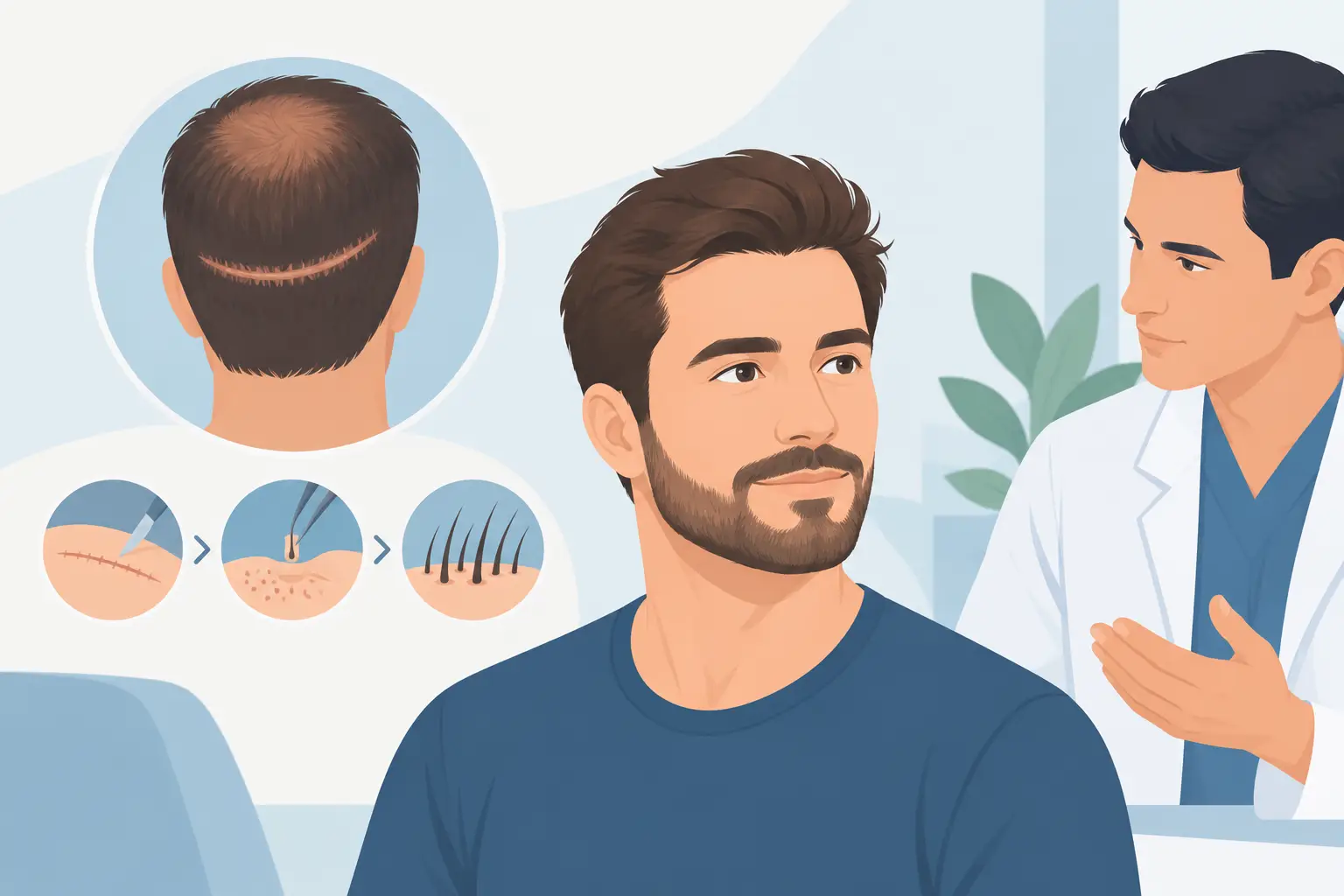
A scar from scalp surgery can feel like a permanent reminder every time you look in the mirror. Whether it followed trauma repair, tumor removal, a facelift incision, a previous hair procedure, or another medical operation, the question is often the same: can a hair transplant be performed after previous scalp surgery? In many cases, yes. But success depends less on the fact that surgery occurred and more on how the scalp healed, how much blood supply remains in the area, and whether the donor zone can safely support transplantation.
This is not a situation for a standard, one-size-fits-all graft plan. Restoring hair around a surgical scar requires physician-led assessment, careful density planning, and an aesthetic approach that respects both the scar and the surrounding natural hair.
Can a Hair Transplant Be Performed After Previous Scalp Surgery?
Previous scalp surgery does not automatically rule out a hair transplant. Healthy, mature scars can often receive transplanted follicles, and a well-designed procedure may soften the contrast between scar tissue and surrounding hair. For many patients, that means greater freedom in how they wear their hair and a welcome return of confidence.
The key distinction is that scar tissue behaves differently from uninjured scalp. It may be thicker, thinner, firmer, less elastic, or have reduced circulation. Since each transplanted follicle needs an adequate blood supply to establish growth, the surgeon must assess the recipient area before recommending treatment.
A transplant may be appropriate when the scar is fully healed, stable in appearance, free from active inflammation, and supported by sufficient circulation. It may need to be delayed or approached differently when the scar is raised, painful, unstable, unusually pale or red, or still changing over time.
The First Question: Has the Scalp Healed Completely?
Time matters because the visible closure of an incision is not the same as complete tissue recovery. For many patients, surgeons prefer to wait at least 6 to 12 months after scalp surgery before considering transplantation. More extensive surgery, complications during healing, radiation treatment, infection, or revisions can require a longer waiting period.
During this interval, the scar often softens and its blood supply matures. It also gives the physician a clearer view of the final scar pattern and any ongoing hair loss around it. Proceeding too early can place grafts into tissue that is still remodeling, making growth less predictable and potentially compromising the result.
If the original procedure was performed for skin cancer or another medical condition requiring surveillance, clearance from the treating specialist may also be necessary. A cosmetic goal should never interfere with medical follow-up or the ability to monitor the area appropriately.
What a Surgeon Evaluates Before Recommending Treatment
A high-quality consultation goes beyond looking at the scar from a distance. The surgeon evaluates its texture, width, color, mobility, thickness, and location. They also examine the surrounding scalp and the donor area, usually at the back and sides of the head, where follicles are more resistant to genetic thinning.
At HairNeva, advanced analysis can help document hair caliber, density, and the pattern of existing miniaturization. This matters because the goal is not simply to put hair into a scar. It is to create an outcome that blends naturally with the hair you have now and remains balanced if future thinning occurs.
The assessment also considers the type of prior surgery. A narrow linear scar from a previous strip hair transplant presents different planning considerations than a larger scar from trauma or a scalp reduction procedure. An incision along the hairline, temple, or crown can require especially precise angle and direction control so new growth follows the natural pattern of the surrounding hair.
In some cases, a surgeon may recommend a small test session. A limited number of grafts are placed into the scar and assessed over several months before a larger procedure is planned. This cautious strategy can provide valuable information about graft survival in that specific tissue.
Choosing the Right Technique for Scarred Scalp
Follicular Unit Extraction, or FUE, is often well suited to patients with a history of scalp surgery because individual follicles are harvested without creating a new long linear incision. Sapphire FUE may support precise channel creation, while DHI can offer controlled placement in selected areas where angle, direction, and recipient-site management are particularly important.
No technique is automatically best for every scar. The real advantage comes from matching the method to the tissue quality, hair characteristics, scar location, and desired coverage. For example, finer hairs may be ideal at a visible frontal scar for a softer transition, while stronger multi-hair grafts can contribute more coverage behind that zone.
Density should be approached conservatively. A scar usually cannot safely support the same graft density as untouched scalp in a single session. Overpacking can compete for limited blood supply and reduce graft survival. A skilled plan may use moderate density first, then add density later if the scar responds well and the cosmetic goal calls for it.
Donor Supply Still Sets the Limits
A scarred recipient area may be treatable, but every hair transplant remains limited by donor availability. This is particularly relevant for patients who have already undergone one or more hair restoration procedures or who have diffuse thinning in addition to the scar.
The surgeon should preserve the donor area rather than chase an unrealistic density target. An honest plan balances the amount of hair available with the size of the scar, the surrounding hair loss pattern, and your long-term expectations. For a broad scar, partial camouflage with an intentionally natural transition can look far better than aggressive grafting that leaves the donor zone depleted.
If the donor reserve is limited, complementary non-surgical options may be discussed to support existing hair. These may include physician-guided regenerative treatments, mesotherapy, laser-supported care, or a medical hair-loss plan when appropriate. They do not replace a transplant into scar tissue, but they can improve the overall visual result by strengthening the native hair around it.
What Results Can You Realistically Expect?
Hair transplanted into a mature, well-vascularized scar can grow naturally and provide meaningful concealment. Still, patients should understand that growth rates can be less predictable than in non-scarred scalp. A portion of grafts may not survive, and a second session may be recommended to refine coverage.
Early shedding after surgery is expected. New growth usually begins gradually after several months, with a more visible change developing between months 6 and 9. Final maturation commonly takes 12 months or longer. Patience matters, especially when transplanting into scar tissue, where the result should be judged only after the follicles have had sufficient time to establish and mature.
The final look also depends on hairstyle. Longer hair can provide excellent camouflage over a scar, while very short cuts may still reveal differences in skin texture or color even after successful graft growth. Your surgeon should discuss this openly rather than promising total invisibility.
When a Hair Transplant May Not Be the Best First Step
Some scars need treatment before they are ready for follicles. Raised hypertrophic scars, keloid-prone tissue, active scalp disease, ongoing infection, or scars with very poor circulation require specialized medical management first. Patients with a history of keloids should disclose it during consultation, as any procedure involving the skin warrants careful risk assessment.
A transplant may also be deferred if hair loss is rapidly progressing or if the donor area is not strong enough to support a worthwhile result. In those situations, stabilizing hair loss, treating scalp health, or reconsidering the aesthetic plan may protect a patient from an outcome that looks good briefly but does not age well.
The right next step is a detailed review of your surgical history, clear photos of the scar and donor area, and an in-person or virtual physician consultation. With mature tissue, a protected donor supply, and a plan built around natural growth patterns, prior scalp surgery does not have to define the way you see yourself.