How Hair Grafts Stay Alive Before Implantation? Learn how hydration, temperature, timing, and skilled handling protect each follicle.
- Why the Time Outside the Body Matters
- How Are Hair Grafts Kept Alive Between Extraction and Implantation?
- Why Handling Technique Is Just as Important as Storage
- Implantation Timing and Technique Shape the Final Result
In this article9
- Why the Time Outside the Body Matters
- How Are Hair Grafts Kept Alive Between Extraction and Implantation?
- Gentle Extraction Protects the Follicle From the Start
- Hydration Prevents Desiccation
- Cooling Slows Cellular Stress
- Why Handling Technique Is Just as Important as Storage
- Implantation Timing and Technique Shape the Final Result
- What Patients Can Do to Support Graft Survival
- The Standard Worth Asking About
A hair graft is at its most vulnerable after it leaves the donor area and before it is placed into its new recipient site. Patients often ask, “how are hair grafts kept alive between extraction and implantation?” The answer is precise clinical control: careful extraction, gentle handling, appropriate hydration and storage, and a tightly managed workflow that minimizes the time each follicle spends outside the body.
For a natural-looking hair transplant, graft survival is not a minor technical detail. It directly influences density, growth quality, and the long-term appearance of the result. A skilled surgical team protects every follicular unit from the moment it is extracted until it is implanted at the correct angle, depth, and direction.
Why the Time Outside the Body Matters
Each extracted graft contains one or more hair follicles along with a small amount of surrounding tissue. Once removed from the scalp, that tissue no longer has its normal blood supply. The graft does not immediately die, but it becomes dependent on the team’s handling and preservation process.
The central goal is to reduce avoidable stress on the follicles. This includes preventing dehydration, limiting exposure to heat, avoiding physical trauma, and keeping the out-of-body period as short and organized as possible. The longer a graft remains exposed or poorly stored, the greater the risk that its cells will lose viability.
This is one reason a high-quality transplant is not defined by the graft count alone. Two procedures may use the same number of grafts, yet the outcome can differ substantially based on surgical planning, extraction quality, preservation standards, and implantation technique.
How Are Hair Grafts Kept Alive Between Extraction and Implantation?
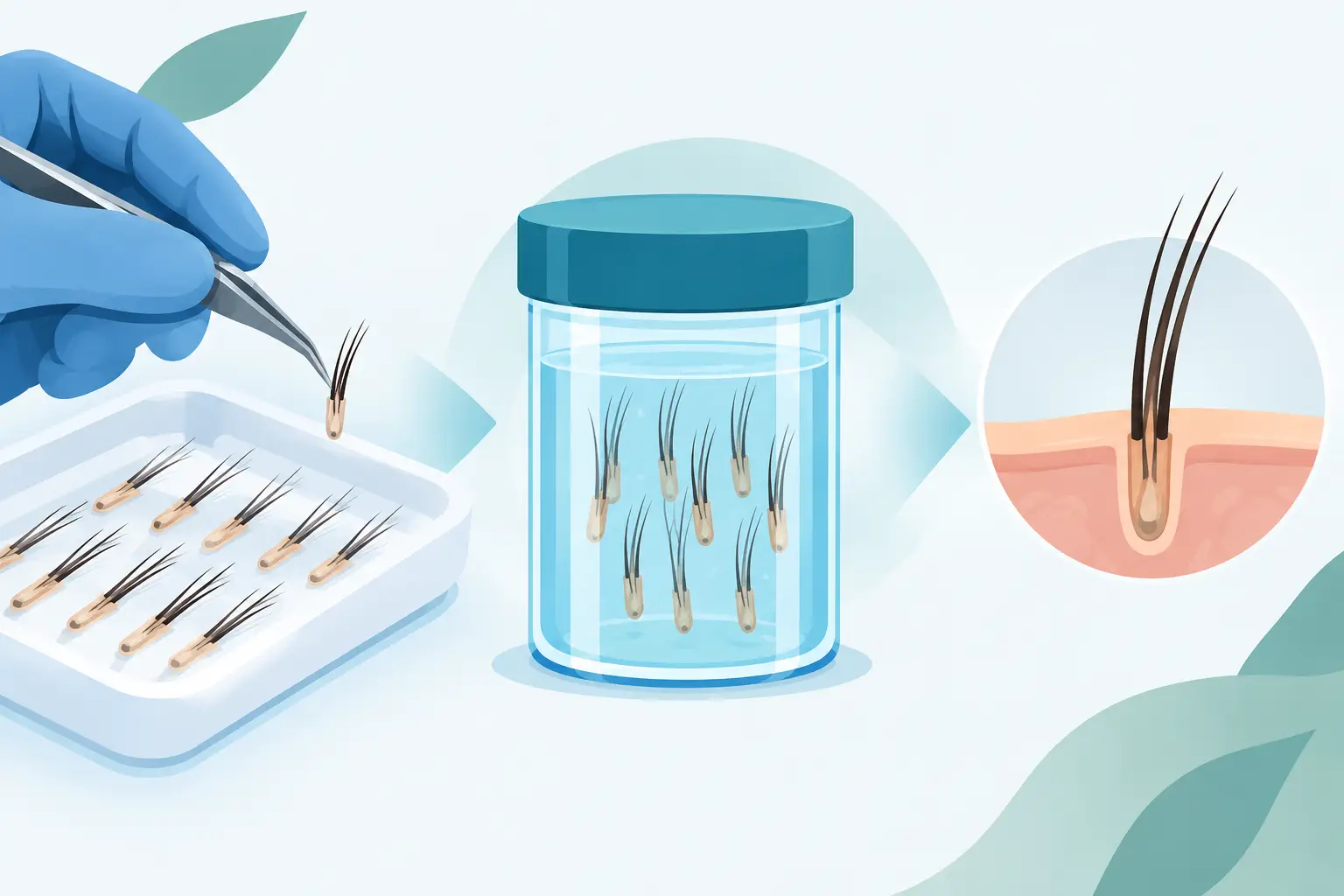
Hair grafts are kept viable through a coordinated preservation protocol. After extraction, they are placed promptly into a sterile holding solution designed to maintain moisture and support the grafts while they await implantation. The solution and storage conditions help prevent the follicles from drying out and reduce metabolic demand during this temporary period.
Temperature also matters. Clinics commonly keep grafts cool, rather than allowing them to sit at room temperature for extended periods. Controlled cooling slows cellular activity and helps preserve the follicles during storage. However, colder is not always better. Grafts must be protected from inappropriate temperatures or direct contact with ice, both of which can damage delicate tissue.
Equally important is the rhythm of the procedure. An experienced team works in carefully coordinated stages so grafts are extracted, sorted, counted, stored, and implanted efficiently. The aim is not simply to finish quickly, but to maintain consistency and precision without unnecessary delays.
Gentle Extraction Protects the Follicle From the Start
Graft preservation begins before the graft enters a storage solution. During FUE, Sapphire FUE, or DHI-based procedures, the extraction phase must be performed with instruments and techniques suited to the patient’s hair characteristics, donor density, curl pattern, and scalp condition.
If a follicle is transected, crushed, or excessively pulled during removal, storage cannot reverse that damage. This is why surgeon-led planning and trained extraction teams are so valuable. They assess the angle and direction of the hair beneath the skin, select an appropriate punch size, and work with controlled movements to preserve the follicular unit.
Curly and Afro-textured hair can require particular expertise because the hair shaft may curve beneath the surface of the scalp. Similarly, fine hair, previously transplanted areas, and limited donor zones call for a more individualized extraction strategy.
Hydration Prevents Desiccation
Follicles are living tissue. When a graft dries out, even briefly, its chances of surviving may decline. For that reason, grafts should never be left exposed on a tray or gauze for longer than necessary.
During the procedure, technicians keep grafts moist in a sterile preservation medium. This is not ordinary water. The solution is selected to provide a suitable environment for the grafts while they are outside the body. It also helps protect against changes in salt balance that could stress the cells.
The exact solution and method can vary by clinic, procedure length, and physician preference. What should not vary is the discipline: immediate placement, sterile handling, and continuous attention to graft hydration.
Cooling Slows Cellular Stress
Once removed, a graft continues to use energy even though it is no longer receiving oxygen and nutrients through normal circulation. Controlled cooling helps slow this metabolic activity, allowing the graft to tolerate its temporary separation from the body more effectively.
In a properly managed procedure, grafts are placed in cooled sterile storage conditions and organized by type. Single-hair grafts may be reserved for the hairline, while multi-hair grafts are often used behind it to create density. Separating grafts carefully also prevents repeated handling and helps the implantation team place each unit where it will produce the most natural effect.
Cooling is a preservation tool, not a substitute for efficient surgery. A clinic should still strive to keep the extraction-to-implantation interval as short as practical for every graft.
Why Handling Technique Is Just as Important as Storage
Hair follicles are small, but they are not indestructible. Excessive pressure with forceps, rough sorting, repeated movement, or holding the graft by the bulb can cause trauma. The safest approach is to handle grafts minimally and by the surrounding tissue rather than the most fragile follicular structures.
A well-trained team also avoids overcrowding grafts in storage, maintains a sterile field, and keeps close track of the graft inventory. This level of organization matters when creating a refined hairline, restoring a beard, or rebuilding eyebrow density, where every graft has a highly visible role.
At HairNeva, the focus on physician-led planning and advanced hair restoration techniques supports this type of precise graft management. Preservation is part of a larger aesthetic process that includes donor protection, recipient-site design, and careful placement for natural growth direction.
Implantation Timing and Technique Shape the Final Result
The recipient area is prepared with channels or implantation sites designed around the patient’s facial proportions, existing hair pattern, and future hair loss risk. This step should be completed in a way that allows the team to implant stored grafts methodically, without extending their out-of-body time unnecessarily.
With traditional FUE or Sapphire FUE, grafts are placed into pre-made channels. With DHI, specialized implanter pens may allow the team to place follicles directly while controlling depth, angle, and direction. Neither approach automatically guarantees better graft survival. The best method depends on the patient’s scalp, desired density, hair characteristics, and the experience of the medical team.
The key is that implantation must be gentle. A graft can be healthy when it leaves storage but still be compromised if it is forced into a site that is too narrow, too shallow, too deep, or poorly angled. Proper placement protects the graft and supports natural-looking emergence once growth begins.
What Patients Can Do to Support Graft Survival
Most of the critical preservation work happens inside the operating room, but patients still contribute to the environment for healing after surgery. Follow the clinic’s aftercare instructions closely, especially during the first 10 to 14 days when newly placed grafts are settling into the scalp.
Avoid touching, rubbing, scratching, or dislodging the transplanted area. Sleep as directed, protect the scalp from direct sun exposure, and avoid strenuous exercise, smoking, and alcohol for the recommended period. These instructions are not cosmetic formalities. They help reduce swelling, trauma, and circulation-related stress while the grafts establish a blood supply in their new location.
Patients should also keep expectations realistic. Preserved grafts do not produce immediate visible growth. Transplanted hairs often shed in the weeks after surgery, which is a normal part of the cycle. New growth typically begins gradually over the following months, with maturation continuing for up to a year or longer depending on the individual.
The Standard Worth Asking About
When comparing hair transplant clinics, ask how grafts are stored, how long they typically remain outside the body, who handles them, and how the clinic manages quality control throughout the procedure. Clear answers signal an organized medical process rather than a volume-driven approach.
The best transplant results are built through hundreds of careful decisions, many of which patients never see. Every protected graft represents a new opportunity for natural density, a balanced hairline, and the confidence to stop thinking about hair loss every time you face a mirror.