Implanter Pens in Modern Hair Transplantation
What is the role of implanter pens in modern hair transplantation? Learn how DHI placement supports precise angles, density, and natural-looking results.
- What Are Implanter Pens?
- The Role of Implanter Pens in Modern Hair Transplantation
- When DHI Implantation May Be a Strong Option
- Implanter Pens vs. Channel Opening and Forceps Placement
In this article10
- What Are Implanter Pens?
- The Role of Implanter Pens in Modern Hair Transplantation
- Precise control of angle and direction
- Consistent depth for graft protection
- Reduced handling during placement
- Strategic density in visible areas
- When DHI Implantation May Be a Strong Option
- Implanter Pens vs. Channel Opening and Forceps Placement
- What Patients Should Ask Before Choosing a DHI Procedure
- The Result Still Depends on Planning
A transplanted hair graft can be healthy, carefully extracted, and still look unnatural if it is placed at the wrong angle or too deeply. That is why patients asking, “what is the role of implanter pens in modern hair transplantation?” are asking an important question. An implanter pen is not simply a tool for speed. In the right hands, it gives the surgical team controlled placement of each graft, helping create hairlines, part lines, and density patterns that respect how your hair naturally grows.
For patients traveling for a hair transplant, the distinction matters. The technique chosen should support a personalized plan based on your donor supply, hair caliber, curl pattern, degree of thinning, and long-term expectations. Implanter pens can be a valuable part of that plan, but they are not a substitute for medical judgment, artistic design, or surgeon-led oversight.
What Are Implanter Pens?
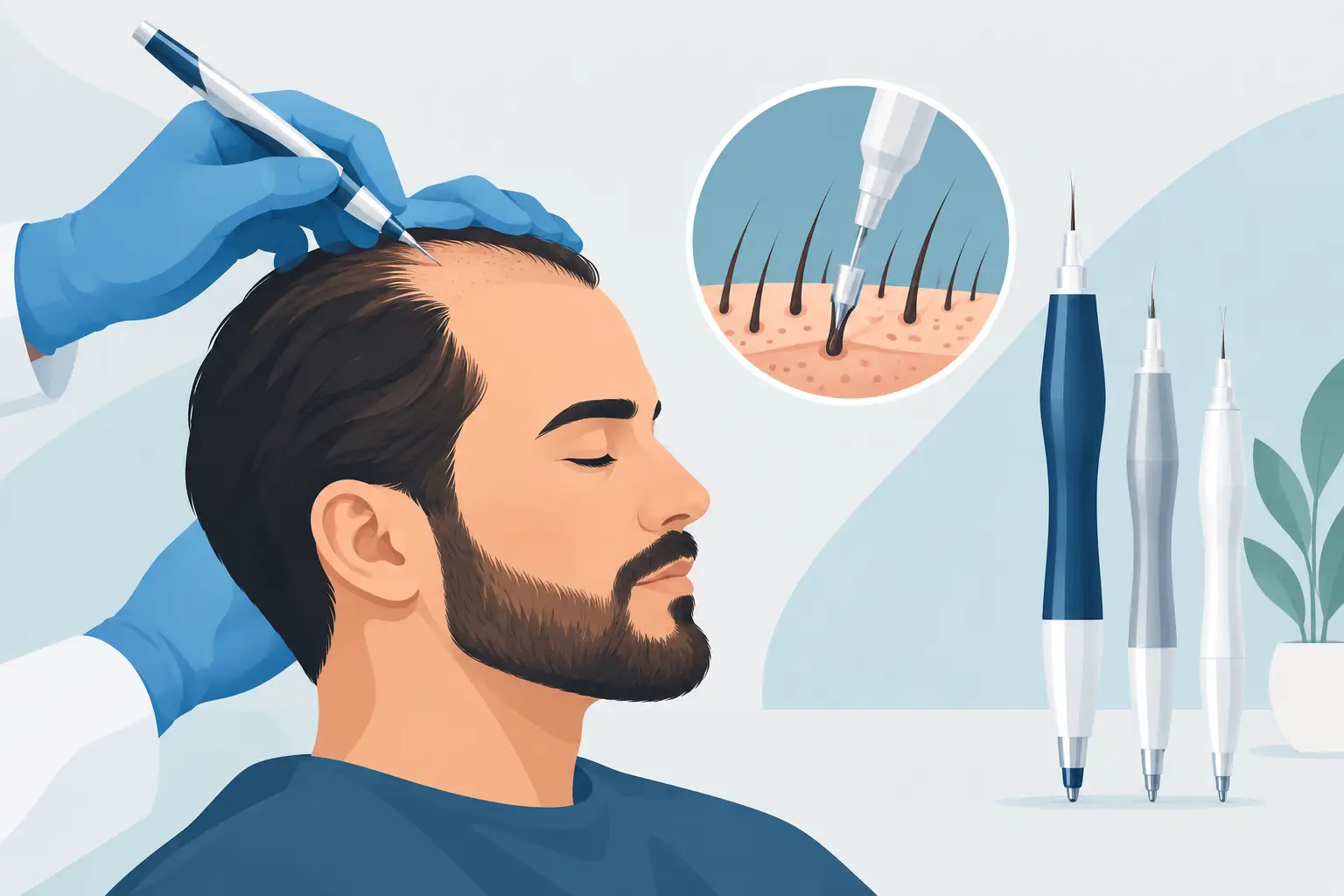
An implanter pen is a specialized instrument used during the implantation stage of hair transplantation. It is often associated with DHI, or Direct Hair Implantation, and may also be called a Choi implanter pen. The device has a fine hollow needle or tip that holds an individual follicular unit graft. Once positioned in the recipient area, the practitioner releases the graft through a controlled plunger mechanism.
The key feature is that the pen can create the recipient opening and place the graft in one motion. In a conventional FUE procedure, the surgeon or medical team typically creates recipient channels first, then places grafts into those sites with forceps or an implantation tool. Both approaches can produce excellent, natural-looking results when planned and performed properly.
Patients sometimes hear “DHI” and “FUE” presented as opposing procedures. Medically, this can be misleading. FUE describes how follicular units are extracted from the donor area. DHI generally describes a method of implanting those extracted grafts with implanter pens. A procedure may therefore involve FUE extraction followed by DHI-style implantation.
The Role of Implanter Pens in Modern Hair Transplantation
Modern hair restoration is increasingly focused on controlled, natural aesthetics rather than simply placing the highest possible number of grafts. Implanter pens help support this goal by allowing careful control over graft depth, direction, and distribution.
Precise control of angle and direction
Hair does not emerge from the scalp vertically. At the frontal hairline, it lies close to the skin and changes direction in small, deliberate variations. In the temples, crown, beard, and eyebrows, the pattern is even more specialized. Placement angle determines whether transplanted hair blends into existing hair or appears too upright and plug-like.
With an implanter pen, an experienced team can place grafts at carefully selected angles while minimizing repeated handling. This can be particularly useful in delicate zones such as a refined frontal hairline, a female part line, an eyebrow, or a beard design. The pen does not create artistry by itself, but it can give a skilled practitioner a precise way to execute the planned design.
Consistent depth for graft protection
Grafts need to be placed at an appropriate depth. Too shallow, and they may be unstable or become more visible during early healing. Too deep, and they may be placed in a way that affects the appearance of growth or stresses the surrounding tissue.
Implanter pens are available in different tip sizes to accommodate varying graft types. Single-hair grafts used for softening a hairline need different handling from multi-hair grafts intended to build density behind it. Matching the tool and technique to the graft type helps protect the follicle and supports a more refined result.
Reduced handling during placement
Hair grafts are living tissue. Every stage, from extraction to storage and implantation, should be managed with care. Because a graft can be loaded into the implanter and placed directly into the recipient area, the process may reduce the amount of manipulation required during implantation.
That benefit depends on disciplined technique. Poor loading, excessive force, unsuitable tip size, or inexperienced placement can damage grafts rather than protect them. The instrument is only as reliable as the protocol and people using it.
Strategic density in visible areas
Implanter pens can allow close, controlled placement where appropriate, especially in the frontal zone and areas requiring a visual density boost. This may be helpful for patients with fine hair, diffuse thinning, or a desire for a fuller-looking hairline without an artificial wall of density.
However, close packing has limits. The scalp needs adequate blood supply to support healing and graft survival. A responsible surgeon evaluates skin quality, vascularity, existing hair, donor capacity, and the total area requiring coverage before recommending an aggressive density plan. More grafts in one session is not automatically a better result.
When DHI Implantation May Be a Strong Option
DHI-style implantation with implanter pens may be particularly appealing for patients seeking detailed work in smaller or highly visible areas. It can suit hairline refinement, localized thinning, unshaven hair transplant procedures, eyebrow restoration, and selected beard transplantation cases.
For women who need discretion and preservation of existing hair, a carefully planned approach can be especially valuable. Likewise, patients with curly or Afro-textured hair require a technique that accounts for the curve of the follicle below the skin as well as the visible curl pattern. In these cases, physician assessment and team experience are more meaningful than any single device label.
At a surgeon-led clinic, the decision should begin with diagnosis. Not every thinning pattern is stable, and not every patient is an immediate surgical candidate. Medical treatment, regenerative support, or a staged plan may be recommended before or alongside transplantation to preserve native hair and protect the long-term result.
Implanter Pens vs. Channel Opening and Forceps Placement
Neither implanter pen placement nor pre-made channel placement is universally superior. They are different technical approaches with different strengths. Channel opening can give a surgeon very direct control over the complete recipient-site pattern before implantation begins. This can be advantageous when designing complex direction changes, planning large coverage areas, or working around substantial existing hair.
Implanter pens combine site creation and placement, which may be efficient for specific cases and can support precise placement in targeted areas. Yet they require grafts to be loaded correctly and a team trained to maintain consistent depth and angle throughout the procedure.
The best choice depends on the patient. Hair characteristics, recipient-area size, desired hairstyle, donor availability, scalp condition, and whether the patient wishes to keep their hair unshaven all affect the recommendation. A premium treatment plan should explain not only which method is being proposed, but why it fits your anatomy and goals.
What Patients Should Ask Before Choosing a DHI Procedure
Rather than choosing a procedure based on a marketing label, ask who designs the hairline, who performs the extraction, who creates or controls the recipient sites, and who handles implantation. Ask how grafts will be sorted and protected, how donor harvesting will be limited to preserve future options, and what density is realistically achievable in your case.
It is also reasonable to ask for before-and-after results from patients with a similar hair type and level of loss. Look beyond immediate post-procedure photos. Mature results reveal whether the hairline has softened naturally, whether the donor area remains balanced, and whether the overall design will continue to look appropriate as you age.
HairNeva approaches implanter-pen procedures as part of a customized surgical plan, supported by detailed hair analysis and physician-led aesthetic design. For international patients, this level of planning is particularly important because the treatment should be clear before travel and the aftercare plan should remain practical once you return home.
The Result Still Depends on Planning
An implanter pen can support natural angles, controlled depth, and efficient graft placement. It cannot correct an overly low hairline, replace a limited donor supply, or guarantee density that the scalp cannot safely support. The most convincing hair transplant results come from restraint as much as technical capability: a hairline designed for the individual, grafts allocated intelligently, and a method selected for the right reasons.
If you are considering transplantation, focus less on whether a clinic uses a pen and more on how its medical team will use every available tool to protect your grafts, preserve your donor area, and create a result that still feels like you years from now.