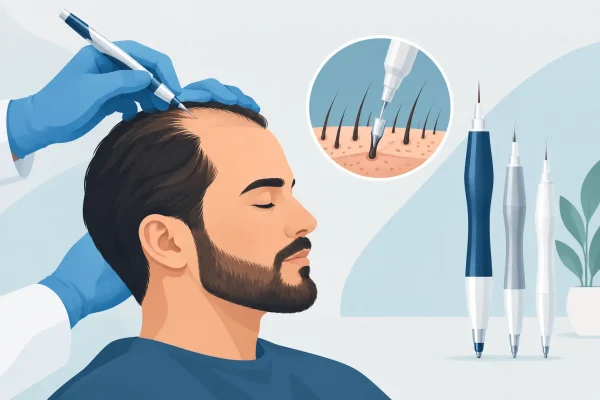
Stem Cell vs Exosome Hair Therapy Compared
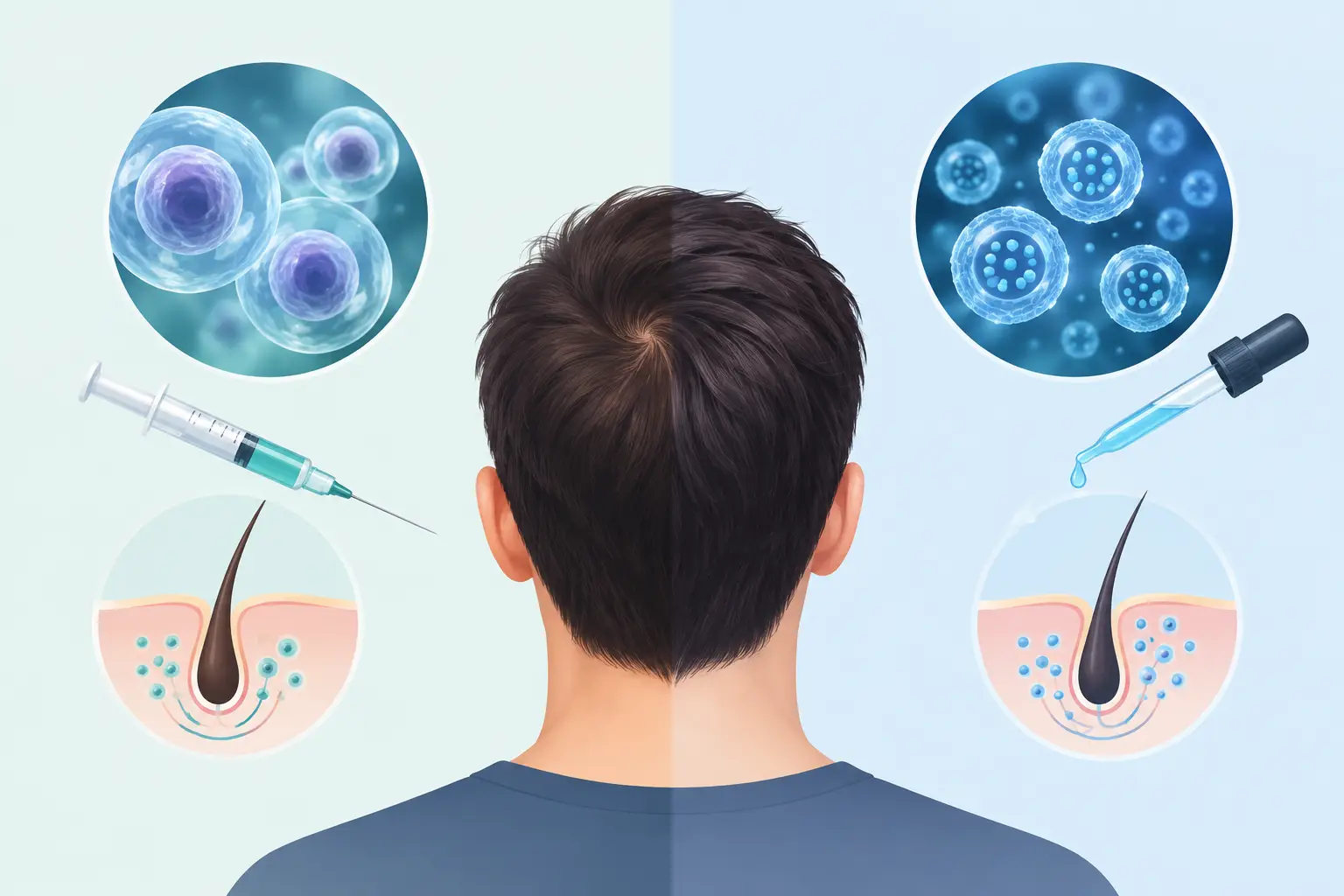
Compare stem cell vs exosome hair therapy for thinning hair, including candidacy, safety, recovery, evidence, and how to choose a physician-led plan today.
- Stem Cell vs Exosome Hair Therapy: Key Differences
- What These Treatments Can Realistically Address
- Evidence, Safety, and the Questions Worth Asking
- Recovery and When Results May Appear
In this article5
A widening part, a softer hairline, or less density under bright office lighting can change how you present yourself long before hair loss becomes obvious to anyone else. For patients comparing stem cell vs exosome hair therapy, the central question is not which treatment has the more advanced name. It is which approach fits the cause, pattern, and stage of your hair loss – and whether the treatment is being recommended with appropriate medical judgment.
Both options are regenerative, non-surgical treatments intended to support a healthier scalp environment and existing follicles. Neither is a substitute for a hair transplant when follicles have been permanently lost, and neither should be presented as a guaranteed cure. A careful assessment creates better expectations and, ultimately, more natural-looking decisions.
Stem Cell vs Exosome Hair Therapy: Key Differences
Stem cell therapy and exosome therapy are related through regenerative medicine, but they are not the same procedure. The difference matters because the source material, proposed mechanism, preparation, and evidence base can vary substantially between clinics and products.
Stem cells are cells with the capacity to self-renew and to develop into specialized cell types. In hair restoration settings, the phrase “stem cell therapy” may describe several very different approaches. Some protocols use a patient’s own tissue, often processed to obtain a cell-rich preparation. Others use laboratory-derived products or growth-factor-rich preparations. The exact method should be clearly explained before treatment, including what is being injected, where it comes from, and how it is prepared.
Exosomes are tiny extracellular vesicles released by cells. They carry signaling molecules, such as proteins, lipids, and genetic material, that may influence communication between cells. In scalp applications, exosome products are intended to support the follicular environment and may help reduce inflammatory signaling or encourage growth-phase activity. They are not living stem cells, and they do not create new follicles.
Put simply, stem cell-based approaches focus on cells or cell-rich material, while exosome therapy focuses on cell-to-cell signaling products. In practice, however, product quality and physician protocol often matter more than the label alone.
| Consideration | Stem cell-based therapy | Exosome therapy | |—|—|—| | What it uses | Cells or cell-rich material, depending on the protocol | Cell-derived signaling vesicles | | Treatment goal | Support scalp and follicle biology | Support follicle signaling and scalp environment | | Typical experience | Usually minimally invasive injections | Usually minimally invasive injections or scalp delivery | | Key variable | Source, processing, and concentration | Product sourcing, handling, and characterization | | Best next step | Confirm the exact protocol with a physician | Confirm the exact product and protocol with a physician |
What These Treatments Can Realistically Address
Regenerative hair therapies are most often considered for early to moderate thinning, diffuse density loss, or hair shedding in areas where follicles are still present but producing finer, weaker hairs. They may also be incorporated into a broader plan for patients who want to support native hair before or after surgical restoration.
The strongest candidates are not necessarily those with the most dramatic hair loss. A patient with active follicles, stable expectations, and a diagnosis that has been properly evaluated may have more to gain than someone with a completely bald area. Once a follicle is no longer viable, injecting regenerative products cannot reliably rebuild it. In those cases, follicular unit extraction, DHI, or another transplant technique may be the more direct path to visible coverage.
It also depends on the diagnosis. Androgenetic alopecia, often called male or female pattern hair loss, is different from temporary shedding after stress, illness, weight loss, or hormonal change. Scalp inflammation, iron deficiency, thyroid conditions, traction, and autoimmune hair loss require their own medical considerations. Treating without identifying the cause can waste time during a period when hair may still be preservable.
A high-quality consultation should examine donor and recipient areas, scalp condition, hair caliber, family history, medication use, and the progression of shedding. At HairNeva, physician-led assessment and detailed hair analysis help turn a broad concern about thinning into a plan designed around the individual patient rather than a one-size-fits-all package.
Evidence, Safety, and the Questions Worth Asking
The appeal of regenerative therapy is understandable. Patients want a discreet option with little downtime, no linear scar, and the potential to support their own existing hair. But the science is still developing. Published research on stem cell-derived and exosome-based hair treatments is promising in some areas, yet protocols are not standardized, study sizes are often limited, and results can vary.
For US patients, there is an additional point of clarity: regenerative products marketed for hair growth should not be assumed to have FDA approval simply because they are described as advanced or biologic. The FDA has not approved exosome products for treating hair loss. Regulatory status, sourcing, sterility, and claims should always be discussed openly with a qualified physician.
That does not mean every regenerative treatment is inappropriate. It means the decision deserves the same scrutiny as a surgical procedure. Ask what material is being used, whether it is autologous or donor-derived, how it is stored and handled, what the clinician expects it to improve, and what alternatives may offer stronger evidence for your situation.
Safety also depends on technique. Injections can cause temporary tenderness, redness, swelling, pinpoint bleeding, or headache. Infection risk is low when proper medical standards are followed, but it is never zero. Patients with certain autoimmune conditions, active scalp infections, pregnancy-related considerations, bleeding disorders, or a history of severe allergies may need to postpone treatment or choose another option.
Be cautious of clinics promising a new full head of hair in one session, using vague terminology, or refusing to explain the product. Regenerative treatment should be offered as a measured medical strategy, not as a miracle replacement for transplant surgery or long-term hair loss management.
Recovery and When Results May Appear
Most patients return to normal daily routines quickly after scalp-based regenerative therapy. The scalp can feel sensitive for a short period, and your physician may advise avoiding intense exercise, direct sun, swimming, aggressive scalp massage, or hair coloring for a limited time. The exact aftercare depends on the technique and material used.
Visible change is gradual because hair biology moves slowly. Some patients first notice less shedding or improved hair texture, while meaningful density changes, if they occur, may take several months. A treatment series may be advised rather than a single appointment. Photography and objective hair analysis are valuable because day-to-day mirror checks rarely provide an accurate measure of subtle progress.
Regenerative therapy also works best when it is not isolated from the rest of your care. Depending on candidacy, a physician may discuss medical hair-loss treatments, low-level laser support, nutritional evaluation, scalp care, or a future transplant plan. Combining appropriate treatments can protect native hair while a transplant restores areas where density is no longer recoverable.
How to Choose Between Them
There is no honest universal winner in stem cell vs exosome hair therapy. Stem cell-based treatment may appeal to patients seeking an approach built around their own biologic material, depending on the protocol. Exosome therapy may be considered when a physician believes a carefully sourced signaling product fits the treatment objective. In both cases, the quality of assessment and protocol is more meaningful than marketing language.
Choose a clinic that begins with diagnosis, documents your baseline, explains limitations, and has the surgical capability to discuss every appropriate option. A center focused only on injectable treatments may not be positioned to tell you when a transplant, medication, or observation is the better recommendation.
The right plan should leave you feeling informed rather than pressured. When a physician can explain what remains possible with your existing follicles and what requires surgical restoration, you can move forward with confidence built on clarity – not hype.