Why Incision Angles Matter in Hair Transplants? It guides graft direction, natural density, healing, and a refined hairline result safely.
- Why Incision Angles Matter in Hair Transplants?
- Angle, direction, and orientation are not the same thing
- The hairline requires the finest control
- Incision angles influence the look of density
In this article8
- Why Incision Angles Matter in Hair Transplants?
- Angle, direction, and orientation are not the same thing
- The hairline requires the finest control
- Temple points and side profiles need individualized planning
- Incision angles influence the look of density
- Precision also protects existing hair and grafts
- Technique matters, but the surgeon’s planning matters more
- What patients should ask during a consultation
A transplanted hairline can have excellent graft survival and still look unnatural if the hairs emerge at the wrong angle. That is why is the angle of incisions important in hair transplantation? Because each tiny recipient-site incision determines how a graft will sit, the direction it will grow, and whether the final result blends convincingly with the patient’s existing hair.
Hair transplantation is not simply a question of moving follicles from a stronger donor area to a thinner one. It is aesthetic microsurgery. The surgeon must account for facial proportions, age, hair caliber, curl pattern, native hair direction, and the changing angle of growth across different areas of the scalp. A few degrees can make a visible difference, particularly at the hairline, temples, crown, eyebrows, and beard.
Why Incision Angles Matter in Hair Transplants?
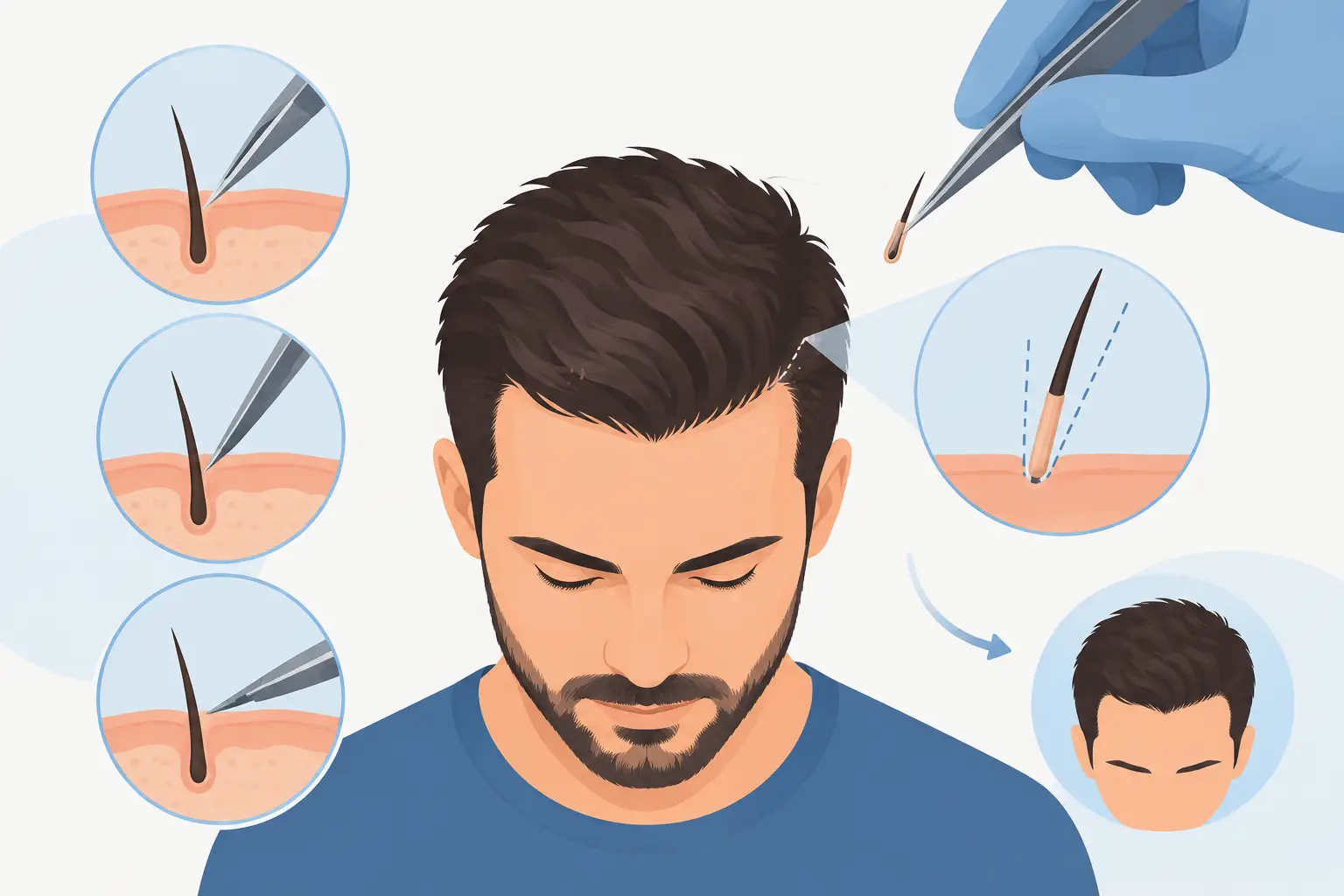
The recipient incision is the small channel created before a follicular unit graft is placed. Its angle controls the angle at which the new hair exits the skin. Once the graft heals and begins to grow, that placement decision cannot be meaningfully corrected without another procedure.
Natural scalp hair does not stand straight up. At the frontal hairline, hairs usually exit at a very acute, almost flat angle. As the surgeon moves behind the hairline, the angle gradually increases. In the temples, hair often lies close to the skin and follows a distinct diagonal pattern. At the crown, follicles grow in a whorl, with direction changing around a central point.
A surgeon who respects these transitions can create a result that appears to have always belonged to the patient. If the incisions are too upright, the transplanted hair may look plug-like, stiff, or disconnected from the native growth pattern. If they are too flat, graft placement can become technically challenging and may affect how closely grafts can be positioned. The correct angle is therefore a balance between natural appearance, graft safety, and appropriate density.
Angle, direction, and orientation are not the same thing
Patients often hear these terms used together, but they describe different parts of surgical planning. Angle refers to how sharply the hair exits the scalp in relation to the skin surface. Direction refers to where the hair points, such as forward, diagonally toward a temple, or around a crown swirl. Orientation concerns how the follicular unit is rotated within the incision, which matters because follicles are not perfectly round structures.
All three must work together. A graft placed at a natural low angle but pointed in the wrong direction can still disrupt the pattern. Similarly, a graft pointing correctly but inserted too vertically can create unwanted lift and make styling difficult.
This is especially relevant for patients with curly, wavy, Afro-textured, or coarse hair. Curved hair shafts can create strong visual coverage, but their direction and exit angle must be planned with greater care. The surgeon needs to anticipate how the hair will curve after it grows beyond the skin rather than judging the result only at the time of implantation.
The hairline requires the finest control
The frontal hairline is where incision angle is most immediately visible. This zone frames the face, and it is often the first area people notice in a close conversation, professional setting, or photograph.
Natural hairlines are soft rather than uniform. They use irregular micro-variations, finer single-hair grafts at the leading edge, and a gradual transition into denser follicular units behind them. The incisions in this area must be shallow enough for hairs to lie naturally forward or slightly to the side, matching the patient’s original pattern.
An overly aggressive hairline is not only about placing it too low. It can also result from grafts that emerge at an overly steep angle. Even with a conservatively designed hairline, upright grafts can make the front appear manufactured. A surgeon-led plan considers future hair loss as well as present appearance, creating a mature, balanced frame that remains credible over time.
Temple points and side profiles need individualized planning
Temple restoration is less forgiving than many patients expect. Hair in this area usually grows in a narrow, flat pattern that differs from the frontal scalp. A generic incision approach may create hairs that project outward instead of flowing toward the sideburn and cheek.
For this reason, temple work requires careful assessment of the patient’s facial structure, ethnicity, age, and existing temple pattern. A natural side profile can elevate the entire transplant, while poorly angled temple grafts can draw attention for the wrong reason.
Incision angles influence the look of density
Density is not created only by the number of grafts placed. It is also shaped by how hair lies across the scalp. When grafts follow the natural low angle and direction of surrounding hair, they overlap more effectively and contribute to fuller visual coverage.
This does not mean that flatter is always better. Very acute incisions may limit surgical access or make placement more difficult in certain areas. The ideal approach depends on the scalp region, hair characteristics, recipient-site condition, and the density target. A skilled team chooses the angle that supports both a natural lay of hair and safe, precise implantation.
At the crown, planning becomes more complex. The whorl has a radial pattern, so the angle and direction must shift gradually around the center. Attempting to force every graft into one direction can flatten the pattern and make the crown look artificial. Respecting the existing swirl is often more valuable than pursuing maximum graft density in a single session.
Precision also protects existing hair and grafts
Recipient-site creation is not just an artistic step. It is a surgical step that affects tissue handling. Incisions must be appropriately sized and spaced for each follicular unit. If sites are too large, unnecessary trauma and reduced control may result. If they are too small or created at an unsuitable angle, insertion can be more difficult and may place stress on the graft.
The depth of the incision also matters. A site that is too shallow may not securely accommodate the graft. One that is too deep can increase tissue trauma and interfere with the desired exit angle. The goal is controlled placement that protects delicate follicular structures while allowing healthy healing.
For patients who still have significant native hair, incision planning must also minimize the risk of damaging existing follicles. This is particularly relevant in female hair transplantation, diffuse thinning, and unshaven procedures, where preserving surrounding hair is central to a discreet, aesthetically refined result.
Technique matters, but the surgeon’s planning matters more
FUE, Sapphire FUE, and DHI can each be used to create natural-looking results when they are performed with appropriate patient selection and technical skill. The instruments and implantation method may influence how recipient sites are made or how grafts are placed, but no device automatically designs a natural hairline or reproduces a crown pattern.
In Sapphire FUE, sapphire blades can allow fine, controlled channels tailored to graft size and intended placement. In DHI, implanter pens can support direct placement with control over depth, direction, and angle. Yet the quality of the outcome depends on the surgical plan behind the technique: where grafts belong, how they should be distributed, and how they must emerge to match the patient’s anatomy.
At HairNeva, this level of planning begins with individualized assessment rather than a one-size-fits-all graft count. A physician-led approach evaluates the donor area, degree of loss, scalp characteristics, and long-term expectations so the design supports a result that remains natural as the patient ages.
What patients should ask during a consultation
Patients do not need to understand every surgical instrument to assess whether a clinic values precision. They should feel comfortable asking how the hairline will be designed, how their natural direction and crown pattern will be mapped, and who will create the recipient incisions.
It is also reasonable to ask for results involving patients with similar hair texture, skin tone, degree of hair loss, or restoration goals. Before-and-after photographs should be examined closely, especially at the hairline and temples. Look beyond graft count. Ask whether the hair appears to lie naturally, whether the transition into native hair is soft, and whether the design suits the individual’s face.
A responsible consultation should also include an honest discussion of limitations. Donor supply is finite, advanced hair loss may require strategic prioritization, and future thinning can change the long-term picture. The best plan may focus first on framing the face and creating natural coverage, rather than trying to chase an unrealistic density target.
The detail patients may never see during surgery often becomes the detail everyone sees afterward. When incision angles mirror the way hair naturally grows, a transplant can restore more than coverage – it can restore the ease of looking in the mirror without seeing the procedure first.